Tuesday, January 31, 2006 

Your guidance and experience is needed: a civil society consultation on universal access to treatment.


This is an email-based consultation with civil society organisations and networks to provide direct input into a Global Steering Committee on Universal Access (see below). All feedback should be sent to the email universalaccess@icaso.org .

In 2005 the G8 and UN Member States committed to "developing and implementing a package for HIV prevention, treatment and care with the aim of coming as close as possible to the goal of universal access to treatment by 2010 for all those who need it, including through increased resources..(sic)".

Based on this commitment, a global initiative on ‘Scaling Up Towards Universal Access’ has been established. UNAIDS states that the process aims to be driven by rapid, inclusive and country-owned processes for setting country-specific goals and targets to be achieved by 2010. It will involve country and regional consultations to identify priorities, opportunities and obstacles to universal access (see note at end).

A Global Steering Committee, co-chaired by UNAIDS and the UK government, has been established to initiate the process, explore global-level solutions to common obstacles, and compile country and regional inputs into a global framework for consideration by the 2006 UN General Assembly Special Session on HIV/AIDS (see the following website for more information http://www.unaids.org/en/in+focus/topic+areas/universal+access.asp).

The ultimate aim is to come up with action plans and clear commitments to address obstacles to universal access at the country, regional and global levels.

There are eight civil society representatives who were invited by UNAIDS to participate in the Global Steering Committee. They are:

* Elizabeth Mataka, ZNAN, Zambia
* Gregg Gonsalves, GMHC, US
* Rodrigo Pascal, GNP+, Chile
* Susan Chong, APCASO, Malaysia
* Bob Vitillo, Caritas Internationalis, Switzerland
* Raminta Stuikyte, CEE-HRN, Lithuania
* Lillian Mworeko, ICW, Uganda
* Anandi Yuvaraj, India HIV/AIDS Alliance, India

These civil society representatives are looking for your critical guidance and input into this process to ensure that your issues are addressed directly in the Global Steering Committee.

This email consultation is being run by ICASO as part of support being provided to these representatives.

The representatives are looking for your guidance and input based on the following key questions:

1. There is no agreed understanding of what is meant by universal access to prevention, treatment and care (e.g.100% access to all, access to all those that need services). What do you understand universal access to mean in your country?

2. What are the key barriers to scaling up responses to HIV/AIDS prevention, treatment and care to achieve universal access in your country by 2010? How can these be overcome?

3. Specifically, what kinds of actions are required, and by whom, in your country to overcome the barriers to addressing the following:
a) Financing and macroeconomic constraints (e.g., TRIPS, patents, budget ceilings);
b) Human resource capacity and health and social service systems constraints;
c) Access to affordable commodities and low-cost technologies (e.g., condoms, ARVs, clean needles);
d) Human rights violations, stigma and discrimination, and lack of equity (including gender).

4. What are the 5 key targets (quantity and quality) that need to be set to reach universal access to prevention, treatment and care in your country by 2010? (e.g., xxx,xxx people on ARV therapy, $x million committed to AIDS by government, compulsory license secured, civil society included in coordinating authorities).

Wherever possible, for each question please provide short descriptions of an actual experience or problem and how it was or could be overcome, and send by email any supporting materials, reports or policy statements that help support your responses to the questions above.

All feedback should be sent to the email universalaccess@icaso.org by Monday 30th January 2006.

Additional note on important dates:

Country and Regional Consultations: December 2005 - March 2006 (you should contact the UNAIDS country and regional offices for details of these consultations
http://www.unaids.org/EN/geographical+area/by+country.asp)

9-10 January 2006: First Global Steering Committee meeting
21-22 February 2006: Second Global Steering Committee meeting
27-28 March 2006: Third Global Steering Committee meeting
31 May - 2 June 2006: UN General Assembly on HIV/AIDS

For more information, please contact: universalaccess@icaso.org


UNDP - Millennium Development Goals

Development divides and digital bridges: why ICT is key for achieving the MDGs, by Mr. Shoji Nishimoto and Ms. Radhika Lal


"While the need for pro-poor policies and increased development finance to scale-up interventions and social and physical infrastructure have been acknowledged as being essential for achieving these objectives, the important role of information and communication technologies (ICT) in facilitating a more effective and transparent use of resources, scaling-up of services, and in catalyzing learning, investment and trade, have not always been factored into MDG-related strategies and there are multiple gains to be achieved from doing so."


COHA Memorandum to the Press

PetroCaribe: Chávez’s Venturesome Solution to the Caribbean Oil Crisis and Trinidad’s Patrick Manning and Barbados’ Owen Arthur’s Ungracious Riposte

• Chávez’s PetroCaribe is the best available solution to the Caribbean’s energy crisis.

• PetroCaribe will propel public sector development of energy infrastructure and promote social programs to help the region.

• 13 out of 15 CARICOM members have signed on, but Barbados and Trinidad and Tobago stubbornly refuse, for mean-spirited, rather than high-minded, reasons.


The unremitting surging global price of oil has crippled the economies of many small, poor nations, and the tourism-dependent Caribbean countries are among the most vulnerable. Into this bleak picture has emerged a possible savior in the person of Venezuelan president Hugo Chávez and his principled PetroCaribe plan.

The arrangement, which was signed with 15 countries last September, promises discounted oil and wide reaching social components. Yet this act of generosity has not gone smoothly, as controversy over the proposal has revealed nasty rifts within the Caribbean Community (CARICOM), primarily involving Trinidad and Tobago’s unflinching and self-interested opposition to the proposal, and Barbados’ equally muscular resistance.

Nonetheless, whatever objections have been raised by these two nations, PetroCaribe is the best offer on the table, and for the 13 CARICOM governments (along with Cuba and the Dominican Republic) that have accepted it, this could prove to be the best exit from their current misery.

Structure of the Deal
As famed Caribbean reporter Tony Best clearly establishes in the January 24, 2006, issue of Carib News, PetroCaribe does not offer cheap oil, as Venezuela’s OPEC obligations prohibit sales at below market value. Instead, its innovative approach allows area countries to defer part of the payment.

The deal functions by a means of a discount whereby contracting countries are required to pay a percentage of the market price, with the remaining cost converted into long term, low interest loans. When market prices rise above US$50 per gallon, as they are now, participating countries will receive a 40 percent discount that will accrue as a 25-year, 1 percent interest loan. If prices rise above US$100, this discount will rise to 50 percent.

Member countries’ debt may be partially amortized by means of paying in goods and services, like Venezuela’s existing arrangement with Cuba. That program is popularly known as “doctors for oil,” in which Cuba sends over ten thousand doctors, nurses, and dentists to provide free health care in clinics in Venezuela’s poorest communities, in exchange for 90,000 barrels of Venezuelan oil per day.

Under the agreement, Venezuela will cover shipping costs, aid in the development of distribution infrastructure and storage sites, contribute to the formation of state-controlled facilities, and provide fuel-efficient systems in member countries. The one catch is PetroCaribe will only deal with a state controlled entity, meaning that the PetroCaribe agreement is based on eliminating all intermediaries. “We're not talking about discounts...We're talking about financial facilities, direct deliveries of products, [and] infrastructure,” said Energy and Petroleum Minister and President of PDVSA, Rafael Ramírez; the goal is to cut down on unnecessary, middlemen costs.

This means that existing U.S. area distributors, Shell and Texaco, would be excluded from purchasing subsidized Venezuelan oil under the envisaged program. In effect, participating CARICOM countries will be edged in the direction of de-privatizing their oil industry infrastructure in favor of setting up state-guided facilities. Distribution will be managed by PDV Caribe, a subsidiary of PDVSA, which will be set up to handle shipment and delivery of the crude, although questions regarding the establishment of regional refining capacity remain.

According to the Oil and Gas Journal, PDVSA has refining facilities in the U.S. Virgin Islands (495,000 barrels-per-day), as well as a 320,000 barrels-per-day facility in the Netherlands Antilles, while other major refineries can be found in Trinidad and Tobago and Cuba. The Jamaican government, spurred by PetroCaribe, has moved forward on a plan to build a refinery on that island as well.

Bonanza from Heaven
Additionally, Venezuela has created a $60 million fund for social projects on Jamaica. For some island economies, PetroCaribe is seen as a bonanza from heaven. Antigua and Barbuda’s Prime Minister Baldwin Spencer has enthused that, “The current crippling impact of continually rising energy costs on our fragile economies is a current case in point.

Venezuela’s offer of stable fuel supplies on concessionary terms through the PetroCaribe initiative is therefore a timely – and welcome – intervention for member countries of the Caribbean Community.” In a like-minded mood, Prime Minister Keith Mitchell of Grenada notes that his country will be able to accrue a total savings of between $10-15 million annually as a result of the Venezuelan deal.

Who’s in, Who’s Out
Initially, PetroCaribe’s was offered to the all 15 CARICOM member countries, Antigua and Barbuda, the Bahamas, Belize, Dominica, Grenada, Guyana, Jamaica, Suriname, St Lucia, St Kitts and Nevis, and St Vincent, the Grenadines, and Trinidad and Tobago, as well as Barbados. However the latter two have quite directly declined the offer. Cuba and the Dominican Republic, who already have existing agreements with Venezuela, are also included in the plan.

Haiti has been at the margins of the deal, as significant controversy revolves around that country’s recent political history. At first, Haiti was not offered inclusion in the PetroCaribe arrangement, as Chávez does not recognize the U.S.-installed controversial Latortue interim government. However, as of early October 2005, Venezuela announced the possibility of Haiti’s participation due to pressure coming from a Haitian interest group, the “Collective to Mobilize against the High Cost of Living,” which Chávez happens to hold in high esteem. As a result, Latortue was allowed to apply for membership in PetroCaribe in November, which would make Haiti the latest country to join, if voted upon.

However, PetroCaribe will not be launched in Haiti until after elections are held and the installation of a new administration in Port-au-Prince. With elections now being postponed to Feb. 7, 2006, for the fourth time since last November, the launch of PetroCaribe’s operations in Haiti may remain relatively remote.

Sitting it Out
Barbados’ decision not to join the other CARICOM nations in signing on to PetroCaribe is based on a smattering of valid reasons and certainly what appears to be an ample dose of exported Washington-influenced paranoia. Barbados produces some oil – although far less than it consumes – and has an existing arrangement with Trinidad and Tobago to refine that oil. Maintaining this refinery relationship, as Barbados’ government has indicated that it felt Venezuela was reluctant to refine the island’s crude, has contributed to Bridgetown’s opposition to PetroCaribe.

Furthermore, the deal between Barbados and Trinidad and Tobago includes a preferential supply agreement, and Barbados claims that any changes to the existing supply chain are only likely to create complications.But such factors aside, it is no secret that Prime Minister Owen Arthur has been a loyal liegeman of President Bush and his litany of other objections to the deal seem to be born out of contrivances rather than on solid grounds, more the results of a man hunting for an excuse rather than one deferring to irresistible logic.

These include his thesis that PetroCaribe will lead to serious debt problems, which seems somewhat silly considering that the region currently must borrow extensively to cover its needs, and that the PetroCaribe loans are based on highly flexible and attractive repayment terms.

Self-Interested Opposition
Trinidad and Tobago, a member of CARICOM whose approximately 150,000 barrel-per-day oil industry and major refining capacity has made the island wealthy, was a logical choice to supply the region with subsidized petroleum. But Port-of-Spain’s oil strategy is partially restricted by its existing international commitments – its industry is closely tied to U.S. oil operations – making options for discounting oil prices to CARICOM countries somewhat limited. Indeed it has always hesitated to extend discounts to its less-fortunate neighbors – a fact which the Caribbean has not overlooked.

Yet despite his unwillingness to step up and help his fellow Caribbean islanders, Prime Minister Manning has continually blasted the PetroCaribe agreement, cautioning that PetroCaribe could force the islands into an agreement which will betroth them to a sole-provider situation, perhaps inexorably locking to future problems.

More stridently, Manning also has blustered that if the region walks away from its current arrangements with him (currently Trinidad and Tobago supplies the region with 60,000 barrels-per-day) and reorganizes its oil sectors under PetroCaribe, his country will look elsewhere for permanent buyers and that in the future the rest of the Caribbean may not be able to count on his country’s previously committed oil supply. Manning spitefully warns that, “it is a question of cutting your own throat if you are not careful.”

This undeniable self-interest – the same attitude that he and Arthur more often than not displayed in their desire to harmonize their position to one which would cause Washington no grief – has been publicly criticized by at least one regional leader, and by several more, privately. Prime Minister Kenny Anthony of Saint Lucia asserts that "Rather than Trinidad and Tobago suggesting that they are incapable, or that they are unable to do anything about the high prices we are forced to pay, they should rethink that position...”

He, of course, believes that Trinidad and Tobago, in fact, is quite capable of providing some formula that could ease the effects of record high oil prices in the Caribbean, but they are not showing any desire or initiative. Instead, fellow `CARICOM members, without any alternative options being placed on the table by Trinidad and Tobago, may have little choice but to go along with PetroCaribe.

The Best Thing Going
PetroCaribe is not without flaws and logistical hang-ups, yet it remains the most concrete proposal on the table to alleviate the region’s suffering. Chávez’s intention is patently not self interest or glorification, as he is not exactly aiding a region with significant global diplomatic or economic clout.

Furthermore, objections to the proposal – specifically by Trinidad and Tobago – are not based on well-reasoned arguments, but rather on stubborn selfishness and shameless servility to Washington.These pitiful motives are often a fact of life when it comes to Arthur – certainly so when it has come to pushing the hapless and inept interim government of Gerard Latortue on the Haitian people at Washington’s behest.

Can Arthur’s heartless Haiti policy in any way be compared to that of the statesmanship of his predecessor Erskine Sandiford who trivializes Arthur by his stature? And Trinidad’s Manning has likewise unwaveringly worked to override moral objectors within CARICOM and extend official recognition to the Latortue regime, going so far as to meet with the interim leader last week in Bridgetown.

In regards to PetroCaribe, Manning’s flat refusal to offer any sort of discount to his neighbors should be a cause for embarrassment, and his haughty threats against those who do accept Chávez’s largesse are shameful at best. PetroCaribe will offer 15 islands the best hope for riding out the energy crisis, and cannot be repudiated as some regional naysayers would very much like to see happen.

This analysis was prepared by COHA Research Associate Kaia Lai, 2006
January 31, 2006

The Council on Hemispheric Affairs, founded in 1975, is an independent, non-profit, non-partisan, tax-exempt research and information organization. It has been described on the Senate floor as being “one of the nation’s most respected bodies of scholars and policy makers.” For more information, please see our web page at www.coha.org
; or contact our Washington offices by phone (202) 223-4975, fax (202) 223-4979, or email coha@coha.org


Learning to listen: technology and poor communities

Waleed al-Shobakky
20 January 2006
Source: SciDev.Net

Bernadine Dias, a Sri Lankan-born scientist based at Carnegie Mellon University (CMU), United States, admits she "wears many hats". Her main focus is robotics, but she also devotes a lot of time promoting innovative ways of using technology in poor communities.

In 2004, Dias founded an initiative called TechBridgeWorld to forge collaborations between CMU and developing communities around the world, including poor neighbourhoods in the United States.

Dias believes this kind of relationship benefits both partners: university staff and students learn about the real needs of the world's poor, while communities gain skills and access to technology.
Ongoing TechBridgeWorld projects are using technology to improve healthcare in Haiti and to teach English in Ghana.

And when Dias moved to Qatar last year to teach in the robotics department of 'CMU-Q', her university's recently launched local branch, she took TechBridgeWorld with her.

As well as introducing the initiative to Qatar, Dias plans to use the country as a springboard to expand into developing communities in Asia and elsewhere in the Middle East.
Working on robotics at the Qatar branch of CMU, says Dias, is an attempt to rectify what she sees as a common misconception: the tendency for consultants and experts to assume that technology that works in the West will also work well for communities elsewhere. From personal experience, Dias believes the notion is misguided.

"Because I grew up in Sri Lanka, I know about experts who have flown in and stayed at five-star hotels for a month, used all the money and come up with solutions that had no relevance at all," she told Gulf Times, a Qatari newspaper, in September 2005.

Dias says this mindset leads to Western products, developed to meet the needs of "a sliver of the world's population", being shipped to communities in developing countries who have not been asked about what they need.

Communicate and collaborate

Dias stresses two reasons why it is important to listen to local communities and develop partnerships with non-governmental organisations. "First, which is obvious, you can't design a solution without grasping the problem — in technology or in any other discipline," she says.

"Secondly, several developing communities have been around for so long, and they managed to live in synch with their environments. We need to learn more about this, not only when designing technology solutions for these communities, but for designing technology solutions in general."

One of TechBridgeWorld's early efforts that highlighted the importance and feasibility of getting local institutions involved was a pilot project in Ghana's capital, Accra. One of Dias's students, Ayorkor Mills-Tettey, went there to see how schoolchildren in poor neighbourhoods would respond to and interact with an automated, English-language, reading tutor developed at CMU. The computer programme works by correcting students reading stories aloud in English if they mispronounce words.

Ghana-born Mills-Tettey needed little more than a laptop and eight headsets. In Accra, she quickly found an Internet café willing to let a group of students use its computers for about an hour a week for the project. She then visited the nearest school and offered to set the project up there. Returning the following day, she found that the head teacher had arranged everything: from choosing students to take part, and organising their consent forms, to arranging a bus to transport them to the café.

"It was amazing," recalls Dias. "All the roadblocks that people said we were going to face were just gone."

Most of the children had never touched a computer before, yet learned to use the programme in 15 minutes. They grasped it not by sitting through the accompanying tutorial but when Mills-Tetty read it out to them. Her familiar accent and the English translations of Ghanaian folk stories that she and her CMU colleagues had programmed into the automated tutor served her well.

"The students loved it, and people were so excited. Here was a new way of getting students interested in reading English, a new way to alleviate the problem of not having enough well-trained teachers," says Dias. TechBridgeWorld is now collaborating with a Ghanaian non-governmental organisation to run the same project, but with more students and for six months, to get more concrete results.

Dias thinks the project could address the problem of the lack of well-trained English teachers in the Middle East too, pointing out that for the project to succeed, whenever it is put to work for a new community, attention should be paid to the delicate differences that distinguish communities, even in the same region.

Moving mountains
Healthcare is another focus for TechBridgeWorld, which is exploring a low-cost project to digitally connect well-equipped hospitals in cities to distant, rural clinics that lack resources. The Albert Schweitzer hospital in Deschappelles, Haiti, is one example.

Connecting the hospital to health centres scattered in mountains eight hours away, could save villagers from having to make daunting and laborious journeys to see a doctor. Digital photos of patients in rural clinics would be sent over the Internet to better-trained physicians in the main hospital, who could then decide whether a disease is benign or serious and whether it warrants quick action.

"We would not need these digital cameras to work 24 hours per day, just one or two hours daily to take all the photos for accurate diagnosis," says Dias.

Dias, who witnessed the impact of the Indian Ocean tsunami while visiting family in Sri Lanka in 2004, is also working on disaster relief, with the aim of developing robot-human rescue teams. Yet with all her projects and plans, Dias believes technology has a long way to go before it can really deliver to poor communities.

"Technology has yet to mature. It's still unreliable," she says, giving the example of computer software that performs differently depending on which operating system the computer uses. She believes that it is only when technology is reasonably reliable that we can use it more courageously in risky endeavours such as landmine detection. "We're starting to witness signs of maturity, though," she adds.

Dias also thinks that awareness is slowly growing of the need for technology providers, particularly multinational companies, to encourage people in poor communities to become financially independent entrepreneurs, not simply consumers or charity-dependent people caught up in cycles of need.

The Indian professor C.K. Prahalad, a management guru at the US-based University of Michigan, led the call for change in his 2004 book Fortune at the Bottom of the Pyramid. The book received much praise from Bill Gates, co-founder of Microsoft and, through the Gates Foundation, a major supporter of science and technology for development.

Dias, too, is enthusiastic. For her, the core of the book's importance is that it invites the business sector to recognise what Prahalad calls "markets at the bottom of the pyramid", and build new products accordingly.

Dias believes that designing technological products specifically tailored to the needs of poor communities is no mean feat. It takes a great deal of creativity and discipline — listening to what communities need.

However, some companies have taken a simpler route to make their products more accessible. In September 2004, Microsoft released in Thailand a low-price, 'watered down' version of its Windows operating system, named Starter Edition.

Generally, the product was not praised by analysts and commentators, but Dias thinks this is not what matters ultimately: "it all comes down to what people in these communities want and can use. If these versions of products are useful to a community, and that community plans to make good use of it, then it is great that they are able to get access to the products... You don't always need the most hi-tech or expensive solutions."

Under the umbrella of TechBridgeWorld, two new courses – both focused on technology consulting for communities, particularly poor ones – will be introduced to undergraduate students at CMU-Q's school of computer science.

As ever, they uphold Dias's belief in mutuality when it comes to encounters between the West and the developing world. As she says: "The most important thing students and faculty walk away with from these courses is the realisation that you can't be an expert on everything, and that you need to listen to, and learn from, your partners in local communities."

Related links:
TechBridgeWorld
CMU's Medical Robotics Technology Center (MRTC)
CMU's Medical Robotics and Computer-Assisted Surgery
Albert Schweitzer Hospital in Haiti


Governance and Corruption in Public Health Care Systems
-Working Paper 78

Download (PDF, 517 KB)

Maureen Lewis
01/26/2006

What factors affect health care delivery in the developing world? Anecdotal evidence of lives cut tragically short and the loss of productivity due to avoidable diseases is an area of salient concern in global health and international development. This working paper looks at factual evidence to describe the main challenges facing health care delivery in developing countries, including absenteeism, corruption, informal payments, and mismanagement. The author concludes that good governance is important in ensuring effective health care delivery, and that returns to investments in health are low where governance issues are not addressed.

© 2005 Center for Global Development.


Caribbean Hotel Association
Caribbean Alliance for Sustainable Tourism launches green globe scheme to protect Caribbean`s environment
Tuesday, January 31, 2006


To help consumers, the Caribbean Alliance for Sustainable Tourism (CAST) has published a webpage that lists properties in the region, responsible performers that have walked the talk and obtained the demanding Green Globe 21 certification. The “Green Globe page” is available from CAST’s website

“Take only pictures, leave only footprints, kill only time.” This adage is well-know to hikers and nature lovers, and it is starting to catch on with other travelers.

While recycling and no-littering are becoming habits at home, thanks to widespread information campaigns, environmentally-conscious visitors can still have a hard time finding options that are environmentally and socially responsible when traveling.

The GREEN GLOBE 21 Company Standard is a benchmarking and certification standard designed for businesses in 25 different sectors of the travel and tourism industry e.g. accommodations, administrative offices, airlines, airports, attractions, cruise vessels, golf courses, restaurants, vehicle rentals, tour operators etc.

The Standard requires an operation to first establish a baseline level of performance or Benchmark for environmental and socially responsible performance.

To be considered environmentally and socially responsible, businesses must meet all of the requirements of the GG21 Standard and be audited before becoming certified and earning the right to display the GREEN GLOBE logo with the tick.

CAST is the Alliance Partner for the Green Globe 21 program in the Caribbean. The region leads the world, with more than 50% of all properties certified by GG21 globally. Certified properties in the Caribbean include:

Antigua
Sandals Antigua Resort
Curtain Bluff Resort
Long Bay Hotel

Aruba
Amsterdam Manor Beach
Bucuti Beach Resort Aruba
Machebo Beach Resort
La Cabana All Suites Resort
Costa Linda Beach Resort

Bahamas
Sandals Royal Bahamian

Barbados
Allamanda Beach Hotel
Almond Beach Club & Spa
Almond Beach Village
Bougainvillea Beach Resort
Hotel Pom Marine

Dominica
3 Rivers Eco-Resort
Fort Young Hotel
Tamarind Tree Hotel and Restaurant

Dominican Republic
Canoa Coral by Hilton
Viva Dominicus Beach
Viva Dominicus Palace
Sunscape Casa del Mar

Grenada
Spice Island Beach Resort

Jamaica
Beaches Boscobel Resort
Beaches Negril
Beaches Sandy Bay
Breezes Runaway Bay
Chukka Caribbean Adventures
Couples Negril
Couples Ocho Rios Limited
Couples Swept Away Negril
Hedonism III
Jamaica Inn
Negril Gardens Resort
Round Hill Hotel & Villas
Royal Plantation Spa & Golf Resort
Runaway Bay Heart Hotel
Sandals Dunn’s River Golf
Sandals Inn
Sandals Montego Bay
Sandals Negril Beach Resort
Sandals Ocho Rios Resort
Sandals Royal Caribbean

Riviera Maya – Mexican Caribbean
Viva Wyndham Azteca Resort

Netherlands Antilles
Lions Dive & Beach Resort

St Kitts & Nevis
Ocean Terrace Inn

St Lucia
Bay Gardens Hotel
Sandals Halcyon St Lucia
Sandals St Lucia Golf
Sandals Grande

Turks & Caicos
Beaches Turks & Caicos

Theodore Koumelis - Tuesday, January 31, 2006


Posted on Tue, Jan. 31, 2006

CARIBBEAN
Trade deal good news for region


BY LUIS PINTO
lpinto@as-coa.org


It hasn't happened often in recent years, but some good economic news is now coming out of the Caribbean. On Jan. 23, the leaders of six Caribbean nations -- Barbados, Belize, Guyana, Jamaica, Suriname and Trinidad and Tobago -- gathered in Kingston, Jamaica, to launch a common market, a goal that has taken more than three decades to accomplish.

After several years of bad news -- including hurricanes, security concerns, migration surges and political instability in Haiti -- the prospects for 2006 are brighter, particularly as the Central American Free Trade Agreement, which includes the Dominican Republic, is fully implemented.

As any economist will tell you, common markets are not perfect. Nonetheless, by agreeing formally to link their economic futures together in this manner, the six Caribbean countries party to the agreement will be better able to leverage their position to attract more and better foreign investment than they would as individual countries.

As a common market they will ensure several trade benefits, including more efficient and effective intra-regional movement of goods and services; a uniform tariff on products imported from other countries that will simplify the ability to do business in the Caribbean; free movement of capital so that money can be moved from one island to another without transaction charges; and a common trade policy leading to a stronger voice in trade negotiations for a Free Trade Area of the Americas (FTAA).

In addition, unlike other hemispheric agreements, under the agreement signed today labor will be free to move throughout the member countries allowing for workers to travel wherever they are needed without lengthy bureaucratic procedures and permits, thus increasing efficiency and regional competitiveness.

Economically, the six signatories are also agreeing to coordinate and converge macroeconomic policies; harmonize foreign-investment policy; and adopt measures to acquire, develop and transfer technology, a critical resource for a region without many other development options beyond tourism and, for some, like Trinidad and Tobago, energy. Finance ministries will also coordinate exchange-rate and interest-rate policies as well as the commercial-banking market.

Pragmatic steps

Such regional economic integration has been on the drawing board for some time. Indeed, those countries within CARICOM that have not signed on to the agreement will continue to be associated with the group as they work to join fully at a later date, thus, leaving the door open to a true pan-regional economic association.

Beyond the Caribbean Basin, 2006 will be a year of economic and political transition for the entire Western Hemisphere. There are elections in Haiti and in numerous other countries, including Brazil, Colombia, Mexico, and Peru -- to say nothing of elections that have already occurred in Bolivia, Chile and elsewhere -- as well as the ongoing negotiations for a freer-trade agreement between the United States and the Andean region. So the shape of the hemisphere is in flux.

Not waiting around, particularly as FTAA negotiations are on hold, Caribbean nations are proactively taking pragmatic steps to compete as best they can in the global economy.

By pushing aside historic rivalries and apprehensions to work more closely together, leaders from these six countries have shown that they understand that they, too, must work to integrate their economies in order to compete.

Hopefully this move toward economic integration, by some of the most vulnerable of our hemisphere's economies, will better prepare the Caribbean Basin for integration through the FTAA. After all, CARICOM started the current integration process on July 4, 1973, and it has only been through perseverance that six of its members have now formalized greater economic collaboration.

With luck and additional perseverance, someday the same thing might be said about the FTAA.
Luis Pinto is a director of the Council of the Americas in Washington, where he follows Caribbean Basin issues.

Miami Herald
Copyright 2006 Knight Ridder All Rights Reserved


Jamaican government committed to promoting human rights, says Governor General

01-31-2006

KINGSTON, Jamaica:


Governor General of Jamaica, Sir Howard Cooke, has said that the government was committed to a foreign policy that promoted international peace, security, human rights, justice and development.

Sir Howard, who was speaking to members of the diplomatic corps at a dinner held in their honour last week, also noted the state’s commitment to a multilateral system of which the art and practice of diplomacy was central.

He further called on the diplomats “to confront the global challenges that are before us as we move through the 21st century…not with pessimism and fear, but with hope and optimism in the intrinsic good of humankind.”

Set to demit office next month after serving more than 15 years as the country’s head of state, Sir Howard said he found his years of service to be very rewarding.

“One of the particular pleasures that Lady (Ivy) Cooke and I have had during my tenure as Governor General has been the opportunity afforded us of meeting members of the diplomatic corps,” he said.

Replying on behalf of the diplomats, Dean of the Diplomatic Corps and High Commissioner of Trinidad and Tobago, Dennis Francis expressed gratitude to the Jamaican government and the Foreign Affairs Ministry, in particular.

He said that Jamaica’s foreign policy was articulated in a most credible manner by a team of professionals within the Foreign Ministry led by Ministers K.D. Knight and Delano Franklyn, and under the astute political direction of Prime Minister, P.J. Patterson.

“The corps has nothing but high regard and appreciation for the staff at all levels of the Ministry, who without failure, make themselves accessible to us, and adopt a supportive posture in advancing the work of our respective missions and indeed, that of the corps as a whole,” the High Commissioner said.

Mr. Francis also expressed thanks to the Governor General and his wife for the hospitality and warmth extended to the diplomatic corps, whenever they visited King’s House.

The diplomatic dinner formed part of activities to mark the eight annual Diplomatic Week.
Jamaica enjoys diplomatic relations with a total of 142 countries, 74 of which have accredited representatives, 29 being resident in the island.

Copyright © 2003-2006 Caribbean Net News All Rights Reserved


China donates US$20,000 to Caribbean Regional Negotiating Machinery

01-31-2006

KINGSTON, Jamaica:


The negotiating efforts of the region have been boosted with a US$20,000 donation to the Caribbean Regional Negotiating Machinery (CRNM) by the Chinese government.

Director General of the CRNM, Ambassador Bernal, who received the cheque last week from China’s Ambassador to Jamaica, Zhao Zhenyu during a courtesy call at the embassy in Kingston, said that the donation would assist the agency as it moved into more complex and detailed negotiations in the World Trade Organization (WTO) and the European Union, for an economic partnership agreement.

“I think this donation is important because it will assist us at this time but also it is a symbol of a deepening relationship between Jamaica and the Caribbean,” he said, noting that the benefits from the negotiations would redound to the entire region.

In reference to the Chinese proverb that says ‘a journey of a thousand miles starts with a single step,’ Ambassador Bernal said, “Today we make the first step and I am sure we are going to journey together as we try to improve the terms and condition under which the Caribbean can participate in global trade, so it is timely and significant and I appreciate it on behalf of the member states of the CRNM.”

Ambassador Zhao Zhenyu, in his reply, emphasized his willingness to foster even better relations between China and the Caribbean, while noting the importance of the CRNM in the development of the region.

“We do hope that the relationship with China and CARICOM will get better and better,” he stated.

Copyright © 2003-2006 Caribbean Net News All Rights Reserved


Rapport National sur le Développement Humain Posted by Picasa


Programme Intégré de Réponse aux Besoins Urgents des Communautés et des Populations Vulnérables en Haïti (PIR)

Un appel des Nations Unies en faveur des populations et communautés vulnérables en Haïti

Haïti défie les définitions classiques de pays en situation de crise humanitaire, conséquence d’une catastrophe naturelle ou d’un conflit armé. Cependant, début 2003, l'ensemble des Agences du SNU en Haïti, suite à une analyse rigoureuse, ont considéré qu'un programme intégré de réponse d’urgence s'imposait pour le pays.

C'est dans ce cadre qu’a été élaboré un Programme Intégré de Réponse aux Besoins Urgents des Communautés et Populations Vulnérables (PIR) préparé par le SNU en Haïti et qui propose une réponse coordonnée, rapide et ciblée pour appuyer une partie grandissante de la population haïtienne ayant atteint un seuil critique de vulnérabilité.

Les ONG nationales et internationales, de même que le gouvernement haïtien sont partie prenantes de ce programme. Le PIR a comme objectif de mobiliser 84 millions de $EU pour la mise en œuvre de ses projets.

- Haïti: L’urgence silencieuse !
- Le Programme Intégré de Réponse (PIR)
- La stratégie du PIR
- La mise en œuvre du PIR
- L’unité d’appui et de coordination du PIR
- Contacts
- Liens utiles

Téléchargez le Programme Intégré de Réponse aux Besoins Urgents des Communautés et des Populations Vulnérables (PIR)
- version française (PDF, 1MB) "French Version"
- version anglaise (PDF, 2MB) "English Version"

Monday, January 30, 2006 

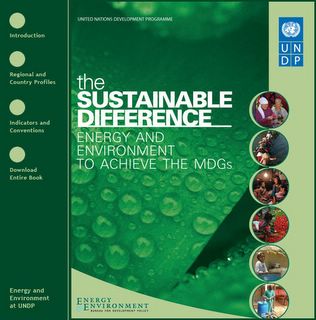
UNDP - The Sustainable Difference Posted by Picasa


"Today, the scientific community increasingly recognizes that environmental degradation is having a significant impact on human development.Notably, it is the poor who are disproportionately affected by the degradation of their land, air,water and biological resources, with many lacking access to clean and affordable water and energy services.

Ensuring environmental sustainability and access to energy services is key to achieving all of the Millennium Development Goals (MDGs) – the eight goals that represent a global commitment to make rapid progress on key development issues.

This book is an important illustration of UNDP’s work on energy and environment for sustainable development and poverty reduction in pursuit of the MDGs.It describes UNDP’s efforts on the ground to support 140 countries to integrate energy and environment issues into their national development plans and poverty reduction strategies through capacity development, policy advisory services and trust fund management."

Download to Entire Book:
http://www.undp.org/energyandenvironment/sustainabledifference/PDFs/SustainableDiffIntro.pdf


La Iniciativa Interamericana de Capital Social, Ética y Desarrollo del BIDa través de su Red Universitaria de Ética y Desarrollo Social (RED)

Convocan a los Instituciones de Educación Superior a participar del:

Programa de Apoyo a Iniciativas de Responsabilidad Social Universitaria, Ética y Desarrollo

El programa incluye asistencia técnica, materiales didácticos para docentes, herramientas de diagnóstico, capacitación y certificado de participación.El programa tiene como objetivos:

1.) Facilitar y asesorar la implementación de iniciativas de Responsabilidad Social, Ética y Desarrollo en las Universidades latinoamericanas.
2.) Elaborar modelos, estrategias e instrumentos pertinentes para facilitar y racionalizar la generación y realización de iniciativas de Responsabilidad Social Universitaria, Ética y Desarrollo en los ámbitos de la gestión, la docencia, la investigación y la extensión universitaria.
3.) Crear mayor sinergia y comunicación entre actores universitarios promotores de iniciativas de Responsabilidad Social Universitaria, Ética y Desarrollo en el continente, a fin de fortalecer la RED y asegurar la sustentabilidad local y el impacto global de tales iniciativas.

Los términos y beneficios del programa pueden ser consultados en el siguiente enlace:

El plazo para presentar propuestas vence el 28 de febrero de 2006. Si desea información adicional, por favor diríjase a: etica@iadb.org


CSME TO BE OFFICIALLY LAUNCHED MONDAY.
THE Caricom Single Market is to be launched in Kingston Jamaica on Monday January 30th.

Barbados, Belize, Guyana, Jamaica, Suriname and Trinidad and Tobago became the first six Caricom countries to have signed on to the single market.

Their premiers, in a 3:00 pm ceremony at the Mona Visitors Lodge, University of the West Indies, will sign a document entitled 'Declaration by Heads of Government of the Caribbean Community Marking the Coming into being of the CARICOM Single Market'.

Six other countries that have committed to membership in the common market by March 31 - Antigua and Barbuda, Dominica, Grenada, St Kitts and Nevis, St Lucia, and St Vincent and the Grenadines - will sign a document titled 'Draft Declaration of Intent by Heads of Government of the Caribbean Community on the Participation of their Countries in the Caricom Single Market.'

During presentation of the 2006 budget on January 20th, Finance Minister Anthony Boatswain said Grenada and the rest of the OECS states which have not yet signed on to the CSM have until March 31st to do so.

He added that a legal expert is working with the Grenada government on drafting the necessary legislation in order that the country becomes fully compliant with the revised treaty. Expressing confidence that Grenada will meet the March 31st deadline, Boatswain said government will also ensure that sensitive industries are not negatively affected by the CSME.

He said there are provisions under chapter seven of the revised treaty that Grenada will use to protect its various sectors as the transition is made to a single economic space.

© GBN


Tourism: Culture and Environment

Washington, Jan 28 (Prensa Latina) "Successful nation branding and promotion are critical to sustainable tourism and development," says Thomas Cromwell, president of East West Communications, a Washington DC agency that advises the Press and Information Department of the UN World Tourism Organization (UNWTO).

One of the world´s leading experts on branding, Cromwell will share his insights as a keynote speaker at Counterpart International´s 8th Caribbean Media Exchange on Sustainable Tourism (CMEx) to be held in San Juan, Puerto Rico from February 9-13, 2006.

The theme for the meeting will be "Sustainable Development: a Balancing Act" and participants will examine how they can motivate the most able people to engage in tourism development that creates wealth while revitalizing local culture and conserving the fragile environment.

Cromwell believes that nation branding can best serve destinations through differentiation, particularly at a time when countries are striving for global unity in terms of infrastructure and quality of life.

Cromwell sees a successful brand as part of a strategy for nations to compete better globally and reap the benefits at home. Branding, he says, can position a nation so that it can achieve the maximum success in the world system, including "garnering maximum international recognition and clout, robust business relations with the world, and a healthy tourism industry."

But as the Caribbean continues to focus on sustainable tourism, Cromwell cautions against depending too heavily on a tourism brand in a region susceptible to natural disasters, especially hurricanes.

To avoid this pitfall for the Caribbean and other regions whose tourism products are "strictly sea, sun and sand," Cromwell supports a holistic approach - a national brand identity that supports tourism as part of an umbrella brand, or metabrand, a term his company has coined.

CMEx is an interactive workshop that allows journalists from the Caribbean, North America and Europe to interact with representatives of the hospitality sector and government and discuss tourism policies aimed at improving the lives of Caribbean people.


Copyright © 2006 - All Rights Reserved.
Prensa Latina

Sunday, January 29, 2006 

$100 Laptop Project Moves Closer to Narrowing Digital Divide

UNDP to support innovative child education project


United Nations, 28 January 2006: The pioneering $100 laptop program, designed to give children in developing countries access to knowledge and educational tools, came a step closer to realization today with the signing of a partnership agreement in Davos between the United Nations Development Programme (UNDP) and One Laptop per Child (OLPC).

Under the Memorandum of Understanding, signed at the World Economic Forum by UNDP Administrator Kemal Dervis and OLPC Chairman Nicholas Negroponte, the project's innovator and director, UNDP will work with local and international partners to design and develop programmes to deliver OLPC technology and learning resources to schools in the Least Developed Countries (LDCs).

"We are delighted to be part of this venture, which has the potential to break through the digital divide between rich countries and poor countries," said Kemal Dervis.

"Though the price of access to knowledge has dramatically decreased in recent years, new technologies remain out of reach for most people in developing countries, especially children, who rarely have access to the educational resources that could enhance their opportunities and lift them out of poverty," he said.

UNDP's global network is on the ground in 166 countries, and has extensive experience in using information and communication technology for sustainable development.

"One laptop per child is key, making learning more seamless with living, play and family life, versus being limited to school. Teacher preparation is important, in parallel with peer-to-peer and self education," said Nicholas Negroponte.

The $100 laptop is an inexpensive, robust computer, with open-source software, and very low power consumption. It can also be powered by hand cranking. The computers form a 'mesh network,' which means that they can talk to each other and several hundred machines can share a single point of access.

OLPC, the non-profit organization set up to oversee the project, was launched one year ago at Davos, and a working prototype of the product was showcased at the World Summit on the Information Society in Tunis in November 2005.

Corporate interest in the project has been high. After reviewing several bids, OLPC announced in December that Quanta Computers would manufacture the laptop; and six companies – Google, AMD, Red Hat, News Corporation, Nortel, and Brightstar, have already provided $2 million each to fund OLPC and the initial laptop design.

OLPC will first implement the program in seven diverse and very large countries. In each of those cases, the government will buy the machines to be given cost-free to students in well specified but large pilot projects. In the case of LDCs and poor countries, the UNDP will work closely with OLPC and other UN agencies on the ground to assist national governments to deploy the laptops to targeted public schools with a variety of internal and external funding sources.

It is expected that the cost of each laptop will come down over time. Manufacturing will begin when at least five million machines have been ordered and paid for in advance, and the preliminary target is to have units ready for shipment by early 2007.

"World demand and goodwill for the $100 Laptop has been boundless because any Head of State realizes that a nation's most precious natural resource is its children," said Negroponte.

###
FOR MORE INFORMATION, PLEASE CONTACT:
Niamh Collier-Smith, UNDP, New York:
Cell: +1 917 213 0671,
Landline: +1 212 906 6111;
Email: newsroom.bb1@undp.org cc'ing niamh.collier@undp.org
Nia Lewis, OLPC, niav@media.mit.edu

For more information please visit:


Accords de prêts entre Haïti et le fonds de l’OPEP pour le développement international
Posté le 25 janvier 2006


Les trois accords de prêt, d’un montant total de dix-huit millions six cent mille dollars, portent sur des projets qui seront exécutés sous la supervision d’unités techniques placées auprès des ministères sectoriels concernés et financés par la BID.

Les trois accords conclus entre la République d’Haïti et le Fonds de l’Organisation des pays exportateurs de pétrole (OPEP) pour le développement international, ont été ratifiés le 14 décembre 2005 en Conseil des ministres et publiés sous forme de décrets.

Le premier accord, conclu en avril 1999, finance le projet d’éducation de base (PEB) du ministère de l’éducation nationale à hauteur de cinq millions de dollars. Les fonds serviront, entre autres, à la réhabilitation de 1280 écoles et à la construction de 400 salles de classe. Le second accord, conclu en septembre 2002, finance à hauteur de six millions six cent mille dollars des projets d’eau potable et d’assainissement, à travers l’Unité de réforme du secteur de l’eau potable (URSEP), placé au ministère des TPTC.

Ces fonds serviront au financement de projets visant à l’amélioration de la qualité et du niveau de service d’eau potable dans environ 10 centres urbains et 50 communautés rurales et périurbaines.

Le troisième accord, conclu en septembre 2005, d’un montant de sept millions de dollars finance différentes activités à travers l’Unité technique d’exécution du programme de réhabilitation des infrastructures économiques de base placées au ministère de l’Économie et des Finances.

Sont concernés les secteurs suivants : les infrastructures de transport et de communication (ports, aéroports), les abattoirs, les marchés, les centrales électriques ainsi que le développement rural.

© 2000, tous droits réservés - Haiti Press Network


Panday, Ramesh, meet Harnarine to discuss crime
Sunday 29th January, 2006


By Leah Mathura-Dookhoo

In an unusual midday meeting yesterday, UNC Chairman Basdeo Panday, along with former Attorney General, Ramesh Lawrence Maharaj met with president of the Hindu Credit Union (HCU) Harry Harnarine to discuss the escalating crime scourge in the country.

Saying that he was deeply disgusted by the crisis the nation has plunged into, Panday said he was willing to meet with anyone who wants a safer T&T.

The closed meeting took place at Rienzi Complex in Couva around the same time UNC political leader Winston Dookeran was addressing members at a seminar in San Fernando on a way forward for the party.

Panday, who hosted the two-hour meeting said he invited Maharaj to join him following a request from Harnarine.

“They wanted to meet with Mr Maharaj and myself to discuss the deteriorating affairs of the country and to see what can be done,” Panday said in a telephone interview.

He said after yesterday’s meeting it is hoped that a united front can be formed with concerned groups to confront the PNM on several issues and to force them out of office.

“We have had 34 of 35 murders in 27 days, this is why groups are meeting with us. People are worried about their safety and they want political change,” he said.

However, the UNC chairman was quick to admit that his party alone could not do it. He said a collective effort from the mature thinking members of society who were concerned about the future generation would assist.

Asked about his relationship with Maharaj, Panday said he was willing to work with anyone who wanted unity and change of governance in the country at this time.

On his absence at Dookeran’s seminar yesterday, Panday said that several things were currently being done at this time to gear up its members for general elections, whenever it is called.

He said yesterday’s seminar and the meeting with officials of HCU did not mean that there was any struggle in the party for leadership, but that everyone was working hard for the good of the party.

Meanwhile, Maharaj who did not want to speak in detail about the meeting at Rienzi Complex said that both he and Panday would meet with HCU members again in the future to continue further discussions on the issue of crime.

“When one is in politics they must put people first. The country needs unity at this time and we must do this to save T&T,” Maharaj said.

©2005-2006 Trinidad Publishing Company Limited


Internet ties
Saturday, January 28th 2006


A recent survey on Internet use in the United States confirms that information technology plays an important role in the life decisions of some 60 million Americans.

The report, titled 'The Strength of Internet Ties' compiled from a survey conducted by Pew Internet, a US-based think tank, found that at present 21 million Americans are using the internet to further their studies at online universities. Some 17 million people use it to conduct research on major illnesses that may be affecting their families or loved ones and a similar number use it to investigate schools before enrolling their children.

The survey found that 16 million people have "surfed the net" before choosing a car and many have actually bought their cars online. Ten million people now use the internet for real estate purposes; to find a place to rent or buy or if they are selling property. And some eight million use it for career changes: to find a new job.

According to a BBC news report, the purpose of the survey was to find out whether the worldwide web and e-mail had strengthened social ties as it had been suggested in the past that web-based communication could diminish real relationships. But the report said that this has not happened. In fact, the researchers found the opposite - Internet communication has helped people in different parts of the world to keep in touch. Free e-mail and instant messaging services have also helped in cases where telephone calls and personal visits would be difficult and prohibitive and regular mail too slow, especially in times of crisis.

And the technology keeps growing more innovative as time goes by. Blogs, websites in which journal entries are posted on a regular basis and displayed in reverse chronological order and which first appeared around 1994, allow people to communicate their thoughts and with anonymity if they so prefer. While many blogs are used to share political views, today there are hundreds where emotional and other support, which was previously only available in individual or group counselling sessions or on crisis hotlines, is available, giving new meaning to the word community.

Meanwhile, an earlier study, also conducted by Pew Internet Project, found that the gender gap existed online although the division was not really in whether men or women used it more; rather it was in how they used it.

Men's usage tended to veer towards information about sports results, weather, news, job offers, recreation, music, hobbies and consumer ratings for goods and services, while women's use involved greater use of e-mail to make and maintain contact as well as searches for health and medical information, map directions and religious material.

In the UK, attempts are being made to integrate older people into the age of modern technology. 'Silver Surfers Day', an annual event observed in May, targets people over 55, aiming to make them less alienated. The proponents of the project see it as vital as it can help reduce the loneliness shut-ins tend to experience.

Last year, online reports say, the worldwide web grew by more than 17 million sites, the most ever in a single year, eclipsing even the 16 million recorded in 2000 at the height of the dot.com boom. Of course the Internet is not nuisance free and a significant number of these flourishing websites are used to sell/distribute pornography, dubious 'health' products and promote scams. Everyone who uses email is bombarded with these 'offers'. There is also online gambling, a fast-growing industry.

While the internet is widely available in Guyana, at offices, net cafes and on a growing number of personal computers in homes, the much-talked-of, long-hoped-for US$22.5M IDB information and communication technology project became bogged down in the failed talks to end telephone monopoly and never came to fruition. The project was to have been mostly educational and would have seen increased access to IT by schoolchildren and perhaps even local 'silver surfers'.

Nevertheless, in his budget speech on Monday, Finance Minister Saisnarine Kowlessar said the government would unfold an IT strategy for Guyana that will hopefully "enable us to realise the goal of seeing every household and school having access to telephones, computers, and high-speed broadband Internet."

He did not say when this strategy would be unveiled or how it would be financed, but since he had also said that the budget was not making "any grand promises", we will have to wait and see.

© Stabroek News


Women's Centre offers education alternatives for pregnant teens
Taniesha Davidson
Sunday, January 29, 2006

THE Women's Centre of Jamaica Foundation (WCJF) has existed now for almost three decades, schooling within that time more than 30,000 pregnant teenagers whose high school education would otherwise have been disrupted.

The foundation also boasts a success rate of 80 per cent, according to executive director Beryl Weir, who says most of its students are re-integrated into high schools and go on to graduate.

Because of the transitional nature of the WCJF, the number of girls enrolled at the centre varies, but can range up to 1,500 per year, says Weir.Last year, 705 students from the centre returned to high school after they had their babies; in 2004, some 532 girls were re-integrated.

The school, which operates islandwide and is the only one of its kind in Jamaica, reflects the type of programme that anti-abortion pro-child advocates say the state and interest groups should offer as alternatives to pregnancy terminations.

The local head of the Roman Catholic Church, Archbishop Lawrence Burke, points, as example, to the Mustard Seed Communities, a church charity which offers pregnant women the option of learning a skill while they carry their babies to term.

But: "We need a lot more of those programmes," he acknowledged in an interview earlier this month with the Sunday Observer.

Three decades ago when teenage girls became pregnant, most of them were thrown out of school, often leaving them with few options for finding employment later, and putting them at risk for subsequent pregnancies.

But in 1978, government established the Women's Centre Programme for Adolescent Mothers on Trafalgar Road in Kingston, offering teens the chance to continue their education during and after pregnancy.In 1991, the programme, now under the portfolio of the Ministry of Local Government, Community Development and Sport, gained 'foundation' status, and became the WCJF.

The WCJF now offers regular high school curriculum - six hours per day, four days per week, to pregnant girls under age 17, and coaches those who are at the required level in the Caribbean Examination Council (CXC) school-leaving exams.Those below graduation age are reintegrated into regular school after giving birth.

"The mandate of the centre is to provide education, training and counseling for the girls here," said Weir. "We provide counseling education for them and then place them back into a high school after they have the child."The girls, she said, have performed well over years with 61.3 per cent CXC passes last year from among 38 students who sat the exams, and 60 per cent in 2004 from among 16 candidates.

Additionally, Weir said the centre also tries to work with the parents/guardian of the girls to ensure that they understand that, legally, they are still responsible for the welfare of their daughters who are still minors.To be accepted as a student at the WCJF, Weir says the teenager must have been enrolled and attending school when she got pregnant.

Registration is $1,000; enrollment is voluntary, and is normally done by recommendation to the centre by the school's guidance counselor. The centre has a few cases where the girls sought out the programme on their own.

Girls who are co-habiting with their partners do not qualify for entry."Most of the girls who come here were not aware of their pregnancies until someone told them," said Weir, "or they are in denial and refuse to accept the pregnancy because it means that they are going to be in trouble with the adults in their lives."

The age of sexual consent in Jamaica is 16, but the average age of the partners of the teens at the centre, according to Weir is 23 to 25 years, and most of the girls are from lower income communities.Weir points out that few of the pregnancies resulted from 'rape', suggesting that the sex was consensual.

However, persons who have sex with children under 16 are subject to criminal prosecution, because those children cannot legally consent to intercourse.

"One of the challenges we have is identifying a rape case - whether it is by rape or other circumstances," said Weir. While the school provides academic classes for the students in areas such as mathematics, English and history, the students are also schooled in childcare, and family planning as well as practical skills.

The girls are strongly encouraged to ensure that their babies are properly immunised, and the centre takes the majority of the mothers on their first visit to the clinic.

"The girls get independent and group counseling to boost their self awareness and self esteem," Weir said."We try to create in them a mindset that is going to cause them to be more focused when they get back to school."After the girls deliver their babies, they are encouraged to continue at the centre for one school term, which lasts three months, before they go back to high school.

During this period, the babies are cared for at the centre's nursery free of cost - very few of the girls give up their babies for adoption - and the new mothers are counselled for integration, which includes a heavy sell for contraception usage.

"This has contributed to the reduction in second pregnancies," said the WCJF executive director, referring specifically to her girls.In fact, Weir claims a 'second pregnancy rate of less than two per cent' among her charges, compared to the national rate of near 25 per cent, according to 2003 figures.

Then some 1,474 teenagers got pregnant a second time of the more than 6,000 teens captured in the National Productive Health Survey.Contributing to the low repeat pregnancy rate is the two-year monitoring that the centre does of the girls who pass through its programme.

"We advice them to admit that they have a child because we realise that if they do that then the students will leave them alone," she said."We also encourage the parents to support their children during this time."

Despite its successes, the centre and its programme are often frowned on."It is still taboo because people feel that this programme encourages teens to get pregnant," said Weir.

© 2000-2001 Jamaica Observer. All Rights Reserved.


Leading by example - Crisis of leadership
published: Sunday January 29, 2006

Don Robotham, Contributor


EVO MORALES, the recently-elected President of Bolivia, has announced that he is to cut his presidential salary by 57 per cent. His salary was a little over US$4,186 or J$263,718 per month, and he has cut it to US$1,800 per month or J$113,400. The new Bolivian President will therefore get about J$1.4 million per year.

The law of Bolivia provides that no public sector employee will get more than the President. The result of this action, therefore, is that the salaries of all public sector employees in Bolivia have thus been cut in half by the stroke of a presidential pen. Mr. Morales had promised in his election campaign that he would cut his salary in half. He has fulfilled his promise in the very first cabinet meeting. He has also suggested that the members of the Bolivian Congress follow suit and also cut their salaries likewise. Time will tell whether they do.

BOLIVIA AND JAMAICA

Although it has huge petroleum and natural gas reserves, Bolivia is even poorer than Jamaica. The GDP is slightly larger than that of Jamaica ­ US$8.8 billion compared to US$7.7 billion. However, Bolivia's population is much larger than ours. Their population is nine million while ours is 2.7 million. Thus Gross National Income per person in Bolivia is as low as US$960 per year, while here in Jamaica it is US$2,900 per year ­ about 36 per cent of ours. GDP growth in Bolivia in 2004 was more or less in the same range as Jamaica ­ 3.6 per cent as against two per cent ­ nothing to write home about.

But it is not just a matter of per capita income. Although income distribution figures for both Bolivia and Jamaica are almost impossible to come by, it is an accepted fact that in both countries income distribution is extremely unequal and getting worse, not better.

An interesting similarity also is that in both countries there is a racial aspect to the social divisions. In Bolivia, it is the descendants of the Aymara Indians (the vast majority) who are poor and the descendants of the Spanish conquistadors who are rich. In Jamaica, the situation is somewhat different: a wealthy light-skinned elite has been recently joined by a new class of black bourgeois and uptown lumpen.

Believe it or not, social conditions for the Indians in Bolivia are even worse than in Jamaica. Life expectancy is 64.1 years, in comparison to our 75.8 years. Infant mortality is an amazing 53 per thousand, compared to Jamaica's 17 per thousand. Net secondary enrolment in Bolivia is 67 per cent, while in Jamaica it is 74 per cent.

Bolivia has huge petroleum natural reserves but these will take many years to develop. As in the case of Nigeria and other oil-rich countries, even when the oil begins to flow, this does not mean that the general population will experience a significant improvement in their social and economic conditions.

MORAL EXAMPLE

President Morales has suggested that the money saved could be used to provide more teachers and doctors to serve the Bolivian people. Of course, his salary cut will not be enough to hire a significant number of health workers. But it may have larger economic significance all the same.

If public sector salaries are cut on this scale, there can be little doubt that it will cut the Bolivian budget deficit and help them to reduce their debt burden. The consequence will be a reduction in interest rates and increased investment in the real Bolivia economy, thereby hopefully reducing unemployment and poverty.

These are all problems with which we are struggling in Jamaica as well. So the Bolivian example is highly relevant to our case. But Morales' step is not only of economic significance. The point of it all is its great moral significance.

We could learn from this example in Jamaica, and not only in the public sector. Relative to our GDP and low levels of productivity, salaries at the managerial level in Jamaica are way too high. This applies not only to public sector salaries but also to those in the private sector.

As in Jamaica, Bolivia faces a very difficult economic situation and President Morales knows it. Although he may be sympathetic to the plight of the poor Indian groups in Bolivia, he knows that in the near term there is very little he can do to improve their economic circumstances.

Even in alliance with the growing group of left-wing countries in Latin America (Brazil, Argentina, Chile, Uruguay, Venezuela and soon Mexico), Morales cannot alter the free market global environment which determines economic and social outcomes in Bolivia and Jamaica. But he can do all he can locally to ameliorate the negative effects and to take advantage of the opportunities of the market.

The point of Morales' salary cut therefore is not only to help the budget, to reduce the debt burden and to stimulate in the real economy. It is also to show that he means it when he says he will put the poor people of Bolivia first. The point is to show that when he calls on the people to sacrifice, which he must, this is not the sort of empty moralistic invocation of 'values and attitudes' which it is common for wealthy politicians to preach in Jamaica. Morales is leading by example.

We sorely need this kind of leadership by example in Jamaica. We have never really had it, even in the 1970s. Today, when the economic pressures on Jamaica are far greater and the room for economic manoeuvre is much smaller, we need leadership by example even more. But not a single candidate for the leadership of the PNP or not one single leader in the JLP has called for this kind of leadership.

Nor have the trade unions. Nor has the Church. Instead of giving leadership, the Church confines itself either to 'bling' or to empty moralistic statements and action which, frankly speaking, cheapen its moral message. If the Church wishes to recover its moral leadership, preaching and praying, however impassioned, will not do it.

The Church, like everybody else, must cut back on its own 'bling' culture and then call for real economic sacrifices at the upper levels of our society, starting with themselves.

JAMAICA IS IN CRISIS

We should not fool ourselves. Jamaica is in a very serious economic, social and political crisis. The root of this crisis is the very same one that is affecting all the countries in Latin America, including Bolivia and Argentina.

None of our economies are in a position to compete in the international market economy in such a way that the majority of our citizens benefit. All of our countries carry severe debts, budget deficits and other shortfalls. As in the rest of Latin America, the Jamaican population has become deeply alienated from the free market policies which have been in place here since Michael Manley abruptly deregulated the economy after 1989.

But this policy environment is not something we can change. In such a context, leadership does not consist of making absurd promises about what one will do for Jamaica if one is elected. We should not be fooled. No leader can carry out such promises. What we really need is not empty promises but leaders who will lead by example of personal sacrifice.

What alienates the Jamaican people is not the free market policies by themselves. It is the inequality and double standards which pervade the society and its leadership. This leadership talks up a storm about what they will do for Jamaica if put in power, but is deathly silent on what sacrifices they are personally willing to make. The poverty rate remains stubbornly at 17 per cent while they zoom off in their SUVs!

The unemployment rate is down to 12 per cent, but the incomes of the employed are extremely low and the politicians increase their pensions to enormous amounts! The mentality at the top is that of the uptown lumpen ­ black and red.

These lumpen are on the edge of power but want to move into the centre. They want to control the state fully so as to rip us off even more. They want to capitalise on the disillusionment of the people exactly in the manner of a 'don' who organises roadblocks and street demonstrations against the police. What does it matter if some of these lumpen are black and others are red?
If the uptown lumpen succeed in gaining political power in Jamaica, we will be moving into the zone currently occupied by Haiti and some African states.

We won't have to speculate about whether we are a failed state then. It will be quite clear to all. Like him or not, Morales has put such lumpen to shame. Take sleep and mark death.


© Copyright 1997-2005 Gleaner Company Ltd.


Worrying labour trends
published: Sunday January 29, 2006

CURRENT PRACTICES and an analysis of emerging trends suggest that this year is shaping up to be a challenging one in managing industrial relations.

The approximately 48 unresolved wage disputes in 2005 continuing into this year, collective agreements set to expire this year in all sectors, and the frequent threat of strikes by the trade unions, set the tone for a disputatious 2006.

Not to be excluded from the mix is the relatively high level of inflation over the last two years, the imminent expiry of the Memorandum of Understanding (MOU) for public sector employees and the temporary closure of the Bernard Lodge Sugar Factory over what the management claims was a series of "unusual events" which rendered some of its key equipment disabled.

There are also proposals on the table to amend the various labour laws, including the Labour Relations and Disputes Act (LRIDA).

We are also quite mindful of the growing complaints of non-unionised workers alleging violation of the Employment (Termination and Redundancy Payments) Act, Minimum Wage and Holiday With Pay legislations and unjustifiable dismissal.

Just under 6,000 complaints from non-unionised workers regarding pay and conditions of employment were reportedly received by the Labour Ministry last year with the majority 31 per cent in relation to employment ­ termination and redundancy payment.

It is our opinion that a first step to defusing workplace conflicts is to improve the process of communication between management and employees as too often, disputes arise because of uninformed decisions and insensitivity.

Disputing parties are reminded of the established machinery for dealing with industrial disputes in accordance with the LRIDA.

As our country strives to achieve the elusive growth, it is important that all disputing parties, for the sake of national development, approach industrial relations in an atmosphere of responsibility and fairness. Industrial turmoil is inimical to economic growth and development.

It is high time the Jamaica Employers' Federation and the Jamaica Confederation of Trade Unions, along with the Minister of Labour, give greater attention to the Labour Advisory Council, especially with the existence of the Caribbean Single Market.


© Copyright 1997-2005 Gleaner Company Ltd.


Forum set on domestic violence
Saturday, January 28, 2006

By LISA S. KING, Freeport News

FREEPORT – The Grand Bahama Crisis Centre in conjunction with the Marco City Urban Renewal programme will host a forum on domestic violence in an effort to heighten awareness and promote further education on this growing social plague on Monday, January 30, at the Foster B. Pestaina Hall of the Pro-Cathedral of Christ the King beginning at 7p.m.

Domestic violence is prevalent world-wide with many of the incidents stemming from violence against current or former spouses, boyfriends, girlfriends and even family members.
Sadly, because of this great scourge, a great number of men and women, but mostly women, are also murdered by their husbands or boyfriends.

According to Dr Jean Turnquest-Brown, head of the Grand Bahama Crisis Centre, domestic violence has become an increasing problem in Grand Bahama and The Bahamas in general.
She said murder statistics for the island shows that domestic violence is often an associated factor. Additional-ly, many individuals are in abusive relationships which they are unable to resolve and often the abuse increases in frequency and in intensity.

Dr Turnquest-Brown states that victims of domestic violence often remain in abusive relationships because of ignorance, for lack of awareness of choices available and many other reasons. "We are inviting everyone to join us as we strive to promote that a victim is not responsible and choices are available," Dr Turnquest-Brown said.

"As we speak out against domestic violence, we are empowered, able to exercise our rights and better protect ourselves. As a result, we can defuse violence in the home and ultimately achieve a reduction in the rate of those murders associated with domestic violence."

In addition to Dr Turnquest-Brown, other panelists speaking at the forum will include Assistant Commissioner of Police Ellison Greenslade, attorney Constance Mc-Donald, Rev. Robert Lockhart and Clarence Riley.

Among the many incidents of domestic violence the island will never forget was the brutal stabbing murder of Tiffany-Smith Laroda, 30, by her husband following an altercation they had had the previous day. Another incident was when 27-year-old Ann Thompson, a mother of four, was discovered by her 12-year-old daughter in the bathroom of her Hanna Hill home with a yellow nylon rope around the neck. Initially, before obtaining the autopsy report, the death was thought to have been an "apparent suicide."

Police investigations later led to her estranged husband being charged with her death.
1833 Corporal Terry Barry, coordinator of the Marco City Urban Renewal Project, said he is very pleased with plans for the upcoming forum, which is expected to give advice on how to decrease violence in the Grand Bahama community.

He said the Marco City Urban Renewal team was able to go into the community, identify its problems and respond by finding the best avenue to deal with them.

"By tapping into the Grand Bahama Crisis Centre, we are able to find help for the domestic problems we had witnessed. The Centre is well equipped and experienced to deal with them," said Cpl. Barry. "So that is what we in the Marco City Urban Renewal do: identify problems in the community and then get certain entities to help deal with the problems."

Mr Barry said in order for any community to grow, become a place of tranquility and for it to remain stable, there must be a participation of all sectors society.

"We are like a bridge between the Government and the community," he said.

Copyright © 2006 The Nassau Guardian. All rights reserved.

Saturday, January 28, 2006 

David Jessop (Executive Director of the Caribbean Council for Europe)


By: WHAT ARE THE PROSPECTS FOR CSME?


For the past week (Jan. 2006) I have been travelling in the Caribbean. Meetings apart, I have been trying to understand the prospects for the Caribbean Single Market and Economy (CSME). I have been asking those that I have met if this vital aspect of the regional integration process can be made to work.

Almost everyone I spoke to agreed that the creation of a CSME was a necessary Carib-bean response to the forces of economic globalisation and competition that threaten to overwhelm the region''s largely insignificant economies.

But when I came to probe just a little deeper, it became apparent that this desire for a regional identity and integration was not matched to any significant extent by the private thinking of some of those who are actively engaged in trying to shape the future.

The more I discussed the issue the more difficult it was to reconcile the contradictions between the genuine commitment to the ideal of regionalism and the reality of the Caribbean of today. What emerged were a number of issues that seemed to require urgent intellectual and practical resolution if the concept of a single market and economy is ever to become a sustainable reality.

DOUBTS TO OVERCOME

1. The first related to whether there is anywhere a successful economic integration movement that involves nations without contiguous borders. The point was made that the fragmented nature of the region with its very small and physically separated nations suggested that the economies of scale that ought to arise from integration were not likely to be present in the Caribbean. As a consequence it may not be possible to rationalise and reduce the costs associated with everything from utilities to manufacturing. Moreover, the inadequacy of inter-Caricom transport systems resulted in high transactional costs of doing business between small island states.

2. The second was whether a region of economies at very different levels of development stands any chance of achieving the consensus necessary to make a single market work. There was widespread concern about the vastly differing levels of development of the CSME''s members and a fear about the possibility that the larger and wealthier may take over the smaller. It was noted that one solution had been proposed to address this: the creation of a regional development fund supported financially by all, that could float less developed econo-mies up to something closer those of the more developed. However, there was a concern that the proposed fund seemed likely to be stillborn because smaller Caricom nations were reluctant to contribute.

3. The third was a real doubt about the ability of the private sector to deliver a single market and whether the majority of companies in the region have any taste for the competition implied by economic integration. It seemed to be little understood in some parts of government that for a single market and economy to work, a vibrant private sector able to mobilise and risk capital for investments is required. Yet much of the private sector remains locked into a form of xenophobic protectionism while a significant part of the rest, the large and successful companies that are able to consider risk, now only invest outside of the region. To further confound the possibility of a single economy the absence of a regional stock exchange made investment across the region and from beyond difficult.

4. The fourth was whether the construction of a single market was politically viable when much of the Caribbean electorate remains sceptical, limiting governments'' room for manoeuvre.

5. And a fifth was the suggestion that the region''s key institutions that should be leading the way had lost touch with the reality of the region. The absence of substantially endowed chairs at the Univer-sity of the West Indies in crime and security and tourism, both now key components in the region''s future were cited as examples. The absence of common policies on regional energy security or food security were cited as other examples that raised questions about the extent to which regional integration can be achieved.

What all of this seemed to indicate was a regional integration movement at best moving at a pace that bears no relationship to the rapidly changing global economy, presided over by regional institutions designed for an age that has passed. What was also striking was how many senior figures privately shared these thoughts, yet despite their creative and new ideas could see no easy way forward.

In the region and beyond some suggest that generational and political change may provide answers. But the lack of any mechanism able to generate regional homogeneity implies that the uniqueness of each Caribbean nation's problems will remain. If this is the case it suggests that a moment will come when policies have to be designed that accept this difficult fact.

© 2003 Pam Democrat. All rights Reserved


Research Competition Posted by Picasa


First Annual Private Sector Development Research Competition

The International Finance Corporation of the World Bank Group and the Financial Times (FT) invite entries for the first international private sector development research paper competition for 2005-2006.

The Theme
“Business and Development: The Private Path to Prosperity” The competition seeks to promote the best thinking on the role of business in development. Papers should add to the global discussion on private sector development and economic growth by providing new and innovative analyses, perspectives, or ideas. The target audience can be economic and financial policymakers, the international financial community, or international/domestic investors.

Awards
Six awards will be granted to the top papers as judged by the Awards Committee:

Gold Award: US$30,000
2 Silver Awards each: US$15,000
3 Bronze Awards each: US$10,000

All papers must be submitted in English and have a maximum of 4,000 words. Abstracts must have a maximum of 300 words. All entries must be received on or before June 30th, 2006.

See Terms and Conditions that apply to all entrants.

Submission
Step 1: Complete and submit this entry form (PDF, 65KB)

Step 2: Submit your paper


Cayman Islands

Domestic abuse support group launched

Thursday 26th January, 2006 Posted: 15:53 CIT (20:53 GMT)


The Women’s Resource Centre has launched a new domestic abuse support group, offering emotional support for women.

Dubbed Journey to Freedom, the group will meet over 12 weeks, giving participants an outlet for their feelings as well as sound background as how to work towards personal growth in all areas of life, said a GIS press release.

The educational component of the group meetings will cover such topics as the types, patterns and cycles of abuse, the effects of abuse on children, power and control in relationships and how to manage healthy relationships, the release said.

“The programme is based on promoting accountability and empowerment, and will allow the participants to challenge themselves to grow,” said WRC Counsellor Cindy Blekaitis.

“It is so important for abused women to know they have support. This group will help them to focus on healing, and it will teach them more about how abuse affects them and their children who might be witnessing it,” she said.

WRC’s overall aim with the group is to provide a comfortable atmosphere where women can develop relationships that are trusting and caring, and where they can find a safe place to talk about abuse.

If you or someone you know could benefit from this programme, please call 949–0006 for confidential help or email cynthia.blekaitis@gov.ky .

Copyright © 2004,2005 Cayman Free Press Ltd. All Rights Reserved.


Le gouvernement haïtien réaffirme sa solidarité envers l'AEC
Posté le 28 janvier 2006

Le Premier ministre haïtien, Gérard Latortue a réaffirmé la solidarité de son gouvernement envers l'Association des Etats caraïbéens (AEC), au cours d'une visite au quartier général de l'association dans la matinée du jeudi 26 janvier.

Le chef de gouvernement haïtien a rencontré, lors de cette visite à Trinidad & Tobago, le secrétaire général de l'AEC, le Dr. Ruben Silié Valdez, à qui il promis que le gouvernement haïtien apportera sa pleine collaboration pour la réalisation des objectifs de l'association, mais aussi participera de manière active à toutes les activités de l'AEC. C'est ce que rapporte une note de presse publiée jeudi par le bureau de presse et de communication du Premier ministre.

Le conseiller politique de l'association, Dr. Watson Denis, et le directeur de transport et du désastre naturel, Louis Carpio, ont fait part au chef du gouvernement haïtien des « idées forces du récent développement dans certains secteurs tels : le commerce, le tourisme, le transport et les désastres naturels. »

Par ailleurs, le secrétaire général de l'association a souhaité que « les prochaines élections se passent favorablement au bénéfice de la stabilité politique, pour le développement socio-économique du peuple haïtien. »

Au préalable, M. Latortue avait évoqué la question des prochaines élections, qui, a-t-il affirmé, vont « être libres et justes, sans l'ombre d'un doute et permettre la participation la plus large possible de la population. »

Gérard Latortue, accompagné alors du représentant d'Haïti auprès de l'OEA, Duly Brutus, et du conseiller en relations internationales, Frantz Louis, a encouragé tous les membres de l'AEC à « travailler avec tout leur cœur pour le succès de cette organisation et pour le triomphe de la politique d'intégration au sein de la grande région caraïbéenne. »

© 2000, tous droits réservés - Haiti Press Network


Caribbean corporate governance forum Posted by Picasa

Corporate Governance is considered to be integral to the development of transparent and properly functioning money and capital markets. Good Governance is also necessary to engender investor confidence and attract liquidity to these markets. However, in an environment where organised markets are nascent and where traditionally, there has been a weak market for corporate control, credible governance structures have not always been demonstrated.

All the regions of the world have established platforms for the advancement of an effective corporate governance movement in their jurisdictions. The Caribbean Corporate Governance Forum (CCGF) is one such platform for the Caribbean region.

The CCGF is working with global organisations such as the OECD, Global Corporate Governance Forum (World Bank), Commonwealth Association of Corporate Governance (CACG) and the Center for International Private Enterprise (CIPE) to advance the corporate governance agenda. It also has several partnerships with institutions in the region that include Central Banks, Securities Commissions, Stock Exchanges, Non-bank Financial Institutions, Chambers of Commerce, academic institutions and others, etc.

Web: http://www.ecseonline.com/corporategovernance.asp


Governor presents fiscal reform plan
By PRWOW News


Gov. Anibal Acevedo Vila on Thursday revealed a series of measures to cut government spending as part of his fiscal reform plan.
The governor’s proposal consists of the following 18 measures:

1. Create a plan to reduce the central government deficit in three years with the approval of the Legislative Assembly.

2. Create a law to make government spending proportionate to the island’s economic growth.

3. Create a Fund of Pressing Interest in order to deposit surpluses to attend to the pension fund deficit, outstanding agency debts, and the Public Improvement Fund.

4. “Pay as you go” (PAYGO) – This measure will require the earmarking of funds for new programs or projects. This bill has already been filed as Senate Bill 1143 and the Government & Labor Affairs Committee has issued a positive report.

5. Once the structural deficit is eliminated, the administration will be forbidden to use public debt in order to cover operating deficits.

6. Ban money transfers between agencies as a means to control government spending.

7. Allow agencies to maintain budget surpluses for two years. These funds may not be used to cover recurrent expenses; only permanent improvements.

8. Submit in-detail report of the financial activity of each government agency 90 days from the end of each fiscal year.

9. Hire more non-profit organizations to provide services to the community. For example: SER de Puerto Rico will provide special education services to public school students.

10. Increase the matching of funds with municipal governments in order to share costs at different levels and delegate responsibility on municipal government structures to implement programs.

11. Eliminate vacant positions from the agency’s classification plan after a thorough evaluation of the Office of Management & Budget and the Commonwealth Human Resources Office.

12. Use economic incentives to promote early retirement.

13. Evaluate the solvency of each government agency to determine whether an early retirement plan can be implemented to reduce the number of people on the government payroll and improve administrative efficiency.

14. Create incentives for private employers who hire government employees.

15. Consolidate government agencies.

16. Create a Permanent Committee comprised of members of the executive and legislative branches, as well as the private sector in order to conduct periodic evaluations of the needs and purposes of different programs, incentives, subsidies, and government agencies and eliminate those that are no longer necessary.

17. The Government Development Bank will create a database of public properties in order to conduct comprehensive studies on how to better use these resources in economic, social, and environmental terms.

18. Create a Fiscal and Administrative Reform Committee at the Education Department, consisting of a multi-sectorial committee in charge of evaluating the agency’s budget and administrative situation to find creative solutions to the department’s deficit. Recommendations will be effective the first day of fiscal year 2007.

Copyright © 2000 - 2006 Casiano Communications Inc. All rights reserved.


Govt approves NAf. 250,520for mental health services

Friday January 27, 2006 - Philipsburg, Sint Maarten, N.A

PHILIPSBURG--St. Maarten recently inched closer towards more effective mental health care services as a result of Executive Council’s approval of funds totalling NAf. 250,520 to execute a downsized plan for the island territory.

Chairman of the Foundation for Promotion and Guidance of Mental Health Care Dr. Michael Mercuur said the foundation had been informed by the Executive Council on January 18 that the funds had been approved.

Mercuur also announced that members of the Foundation had held an introductory meeting with the Executive Council on January 19.

“During this fruitful meeting the foundation was given the opportunity to discuss mental health care and to elaborate on its plans for mental health care services in St. Maarten. The foundation members committed themselves during this meeting to provide psychiatric mental health services to the community by March 1,” he reported in a statement last night.

He also explained that to achieve this, the foundation had already embarked on the recruitment process and its members were trying to identify and secure a suitable location for a clinic in the Philipsburg area. He said formal recruitment would start within the next two weeks and would be advertised in the various newspapers.

“In addition health care providers, insurances and institutions will be approached shortly to provide information and to establish cooperation,” Mercuur reported.

The foundation was established on the initiative of the Island Government of Sint Maarten on October 10, 2001, with a view to developing and installing a system for mental health care in St. Maarten, among other things.

One of the foundation’s first tasks was to develop and to present a business plan on the further development of mental health care in St. Maarten.

“After extensive studies and deliberations with those involved in Mental Health Care, the foundation finally presented two business plan proposals, one being a multi-annual master plan and the other a downsized start-up plan that was presented to the Executive Council on June 7, 2005,” Mercuur explained.

He said the start-up plan “is less extensive, therefore less expensive” and, as anticipated, funding for this plan would be achieved much earlier.

“This plan aims in this phase on providing and enhancing mental health care services to the general public of the Windward Islands, St. Maarten in particular. Therefore the foundation is seeking to attract a director, a psychiatrist and a social psychiatric nurse,” he explained.
One of the main tasks of the director will be to secure funding for continuation, as well as expansion towards the multi-annual master plan.

He said the psychiatrist and the nurse would provide mental health care consultations in office and in institutions like the prison and Turning Point, as well as home care.

“In this phase admissions on island will not be available as yet. Only when more funding is secured can the multi-annual master plan be executed, which will then include admissions (acute and non-acute), day care activities, health promotion activities, etc., in addition to the services offered by the foundation to the community.”

He noted that the foundation had suggested that there should be cooperation with St. Maarten Medical Center (SMMC), for this might lead to sharing of certain services and considerable reduction of expenses. Such cooperation might also lead to ensuring the availability of psychiatric admissions much sooner.

“The foundation is looking into the possibilities of sharing certain services with already established healthcare institutions on the island,” Dr. Mercuur explained.

Copyright ©1998-2005 The Daily Herald

Friday, January 27, 2006 

27th January
Agribusiness And Family Island Employment
Continued from last issue...
Kostas Stamoulis of FAO’s Agricultural and Development Economics Division and one of the project’s coordinators said, “Before one jumps to quick conclusions regarding the role of agriculture in rural income, one should think that many of the rural non-farm activities, such as transportation services and food processing for instance, depend on a strong agriculture for their survival and growth.”


Mr. Stamoulis added: "This study, and the workshop where it was released, marks the first time that non-farm and farm sources of income have been analyzed in such detail, mainly because this has been made possible by the vast amount of household-level data which have been meticulously analyzed and organized."

Top experts at workshop to examine rural development issues

Evidence on the structure of rural income and a number of other issues on the rural economy are being discussed during a two-and-a-half-day FAO workshop, which opened today, looking for creative ways to help rural families escape hunger and poverty.

The workshop, called "Beyond Agriculture? The promise of the rural economy for growth and poverty reduction", brings together some of the top people in agricultural economics from around the world. Issues such as migration, government expenditures for rural areas, marketing chains and their relation to rural economies are being discussed during the workshop. Representatives from multilateral development banks will present and discuss the rural strategies of their organizations.

"In organizing the workshop, FAO is seeking to raise awareness on how recent trends and changes such as globalization shape the context in which rural economies operate and what are the implications for policies to reduce rural poverty," according to Mr. Stamoulis.

The Bahama Journal - Bahamas News Online Edition
Copyright Jones Communications Ltd. ©2005 - Nassau, Bahamas.


25th January
Agribusiness And Family Island Employment
In The Bahamas the rural community is our Family Islands. Those of us who live in the urban centres, Nassau and Freeport, of our country do not appreciate the extent to which Family Island people depend on farming, fishing, food processing, livestock production and forestry activities like cascarilla bark and coal burning for livelihoods. Most of the Small Farmers and many of our agribusinesses are located in the Family Islands.


Over the years, the southeastern Bahamas has been the main locale for the small farmer who is facing extinction as the numbers are dwindling. Young people are no longer attracted to traditional farming.

With the government’s policy of an anchor touristic project for each island, Family Island manpower will be attracted to tourism rather than devising production activity to supply these facilities with fresh produce, meat and fish.

The following article provides some insight.

Despite significant progress in income diversification of rural households, agriculture is still the principal activity of rural households in developing countries, according to a study released today by the UN Food and Agriculture Organization (FAO).

The study, covering three regions of the developing world, shows that 84 percent of rural households participate in agricultural activities and in some countries the number reaches as high as 99 percent.

However, the study also shows that rural households derive a large share of their incomes from non-farm rural activities, and these are often more remunerative. The share of money earned by rural households from such activities varies from region to region and from country to country. For more developed countries like Panama, the share of rural household income derived from non-farm activities reaches 75 percent while for Nicaragua, a lower income country, the share is 28.5 percent.

Institutional Cooperation Leads To Improved Data

The findings are the preliminary results of a joint project by FAO, the World Bank and the American University in Washington, DC. The project, known as the Rural Income Generating Activities (RIGA) project, is building a detailed database to show sources of rural income based on nationally representative household surveys. The ultimate objective is to use country-by-country analysis and cross-country evidence on rural income-generating activities to help reduce rural hunger and poverty.

To Be Continued...


The Bahama Journal - Bahamas News Online Edition
Copyright Jones Communications Ltd. ©2005 - Nassau, Bahamas


Antigua makes push for UN funds
Friday January 27 2006

by Nikisha Smith

The Environment Division is making a concerted effort to secure United Nations funding to pursue sustainable development activities in Antigua & Barbuda.

Yesterday, the Environment Division held the final project stakeholder and steering committee meeting to review and discuss the draft Project Brief submission, which will be made to the UNDP for between US$3 and $4 million.

The United Nations Development Programme (UNDP), the development arm of the United Nations, was designated by the Global Environment Facility (GEF) as one of its three implementing agencies

The GEF, established in 1991, helps developing countries fund projects and programmes that protect the global environment.

Melesha Banham, environment officer, said one of their projects goes to the core of ensuring the security of the livelihoods of Antiguans and Barbudans.

“The project that we were discussing today was the sustainable island resource management mechanism.

“It is a project aimed at looking at resources that are vulnerable and managing those resources in such a way that they become sustainable,” she said.

“They are usually resources that people use as a livelihood, and if these resources are overused, then you stand a chance of them not being able to replenish themselves or a situation where these people will actually lose their livelihoods,” Banham explained.

There are four demonstration projects at the moment, one in Barbuda and three in Antigua.
They were presented by David Vausten, consultant to the Environment Division, who is drafting the proposal.

The first demonstration project is aimed at achieving sustainable land use practices for the conservation of soil and water resources and rehabilitation of the Body Pond watershed on Antigua.

The second project is the development of an integrated “ridges to reefs” co-management approach for the conservation of resources in the South West region of Antigua.
This involves getting the Cades Bay reef declared a marine reserve, along with the Wallings Forest and Fig Tree Drive because of their biodiversity and threatened species of flora and fauna.

The project also looks at Boggy Peak being managed because of the potential impact it may have on those lower ecosystems.

The third project is the integrated planning and management for the sustainable use of Codrington Lagoon in Barbuda, which will also include proper waste disposal.

This will be a continuation of the Caribbean Regional Environmental Programme, which is aimed at maintaining the lagoon as a national park and a means of livelihood for Barbudans.

The last project involves promoting best practices in water conservation and waste water disposal and grey water re-use in the North West tourism zone of Antigua.
The projects will be co-sponsored by the government so that they will play their part to make sure that they succeed.

Banham said the money from the GEF has been earmarked for these projects, but the proposal will have to be submitted by March or else the opportunity will be lost, probably forever, because of other causes.

She said that they were sure, however, that the proposal would be submitted in time.

© SUN Printing & Publishing LTD 2003-2004. All Rights Reserved.


Curriculum reform a necessity in Federation
Friday January 27 2006

Dozens of teachers from across the island were reminded of the importance of curriculum reform as a means of remaining “relevant and competitive in this new global environment.” This ideology was explained by Minister of Education Sam Condor at the East Zone Schools Professional Development Day held at the Tabernacle Community Centre.

Condor, in addressing the gathering said “we must be ever cognizant of the fact that constant review and revision is necessary …

“This notion of an organised and planned set of guidelines and inputs points to the need for a curriculum which supports learning. Therefore, the challenge here is to reform the curriculum, which, when fully implemented, would ensure access to the appropriate equipment, experience and tutorial support, for maximum development,” Condor said.

The education minister said, as part of the reform, teachers must share among themselves, their ideologies and methodologies on effectively passing on knowledge to their students.

Condor told the teachers that, in reference to curriculum reform, “the government has entered into a loan agreement with the World Bank, under an OECS Education Development Project, to continue the curriculum reform.” He further indicated that, as part of the curriculum reform project, a teacher appraisal system will be developed.


© SUN Printing & Publishing LTD 2003-2004. All Rights Reserved.


Guyana

Educational experimentation
Friday, January 27th 2006


This year will be the final year of the Secondary Schools Entrance Examination (SSEE) in its current form. From next year 11-year-olds will be undergoing an assessment, although exactly what form this will take is not something which has been made public as yet; perhaps it will end up being very similar to the current Common Entrance exam.

Whatever the case it can be said that the pupils who undergo the assessment will have already been exposed to two others at an earlier stage in their schooling, and the final result will depend on how they have performed in all three - although each test will have a different weighting.

The general aim is to make secondary schooling available to everyone - no problem there - and to abolish any kind of school selection based on ability; every pupil attaining secondary school age will be expected to attend a school in the vicinity. The new arrangements were partially implemented for the first time last year.

They could not be fully implemented, because there are as yet not enough secondary school places available, and the marks obtained at SSEE were therefore used to place children at the senior secondary schools in addition to some other named secondary schools.

These columns have raised questions before about the advisability of placing children in schools on the basis of assessments made over a period of years; it seems on the face of it, for obvious reasons, inherently unfair. We have also reflected on what the long-term plans are for the senior secondary schools, and whether the Ministry of Education has it in mind to make any arrangements for gifted children as well as those with learning difficulties who cannot manage the pace of an average class.

The education authorities have had nothing to say on these matters as yet, and so perhaps they have not made any final decisions.

One feels that the Ministry might be best advised to make haste slowly until it can fully observe what is happening in England and Wales, on whose system our own experimentation appears to be based. The English abolished their Common Entrance exam many years ago, and introduced arrangements in the state education sector whereby pupils simply graduated to a school in their area of residence - the catchment area principle.

It was not a success in terms of lifting educational standards, quite the opposite in fact. As a consequence, a succession of governments have been tampering with the system ever since.
The removal of the competition element does affect standards, and the authorities in due course introduced what are called League Tables, which publish the performances of the various schools. This has had the unintended consequence of causing the more affluent to move to areas where the schools have a solid reputation, thereby driving up real estate values.

Furthermore, a recent report from the Sutton Trust has said that the most successful comprehensive schools in England are socially selective, and that a disproportionately low number of poorer pupils attend the 200 highest performing comprehensives.

According to the BBC, previous studies had shown that those comprehensives which ran their own admissions were more successful, but at the same time were less likely to take poorer pupils. The Sutton report too alluded to the success of both single sex and faith schools, although here too, interestingly, there was under-representation of the poorest pupils.

When Mrs Thatcher came into office, she attempted an assault on the uniformity of the state system by introducing schools which could opt out, so to speak, called the Grant Maintained Schools. When the Labour government returned in 1997, it promptly abolished these. Now, to the glee of the Conservatives, Prime Minister Blair is proposing to introduce Trust Schools, which among other things will be independent of the local education authorities, and will have greater freedom over admissions and the curriculum. It is proposed that subsidised buses will take children from low income families a distance of up to six miles to attend these schools.
In certain key respects the proposed Trust Schools will be very similar to the Grant Maintained Schools, and the Prime Minister now finds himself in the strange position of facing a possible revolt of 90 of his back-bench MPs, while being able to depend on Tory support.

However, even before the latest proposals for educational reform were made public, the Labour government had introduced what are known as specialist schools, which, as their name suggests, place emphasis on particular (mostly) academic areas. As things stand, these schools are allowed to select up to ten per cent of pupils by aptitude.

The bottom line is that the abolition of aptitude testing at age eleven, while clearly imperfect, has not raised the standard of education of the poorest pupils in England and Wales. This is despite the introduction of assessments in the primary schools, which we appear to be copying. It might be noted in passing, that following objections from parents in Wales, one of these assessments has now been dropped.

We too have had a great deal of tinkering with the education system over the years, with less than successful results. If the English, with all the resources at their disposal, still cannot get it right, we are unlikely to do so by following exactly in their footsteps. In addition, we too have not yet come up with viable arrangements which will raise the educational levels of poorer children, although at least by looking at what happens in other places, we might get an idea of what doesn't work.

In any case, what has to be recognized is that in our case, no matter what system is in place, without a sufficient number of competent teachers to staff the schools nothing will work.

© Stabroek News

Thursday, January 26, 2006 

Thu Jan 26, 2006
Is JA ready for the Caricom Single Market?


Three days before the signing of the document which will officially inaugurate the Caricom Single Market (CSM), Opposition Leader Bruce Golding is questioning Jamaica's readiness for the move.

According to Mr. Golding, while the CSM is being heralded as a great step forward, Jamaica is not equipped for the journey. However Mr. Golding was quick to point out that he is not suggesting that Jamaica should not go the route of the CSM. He was speaking at the Hardware Merchants Association luncheon at the Knutsford Court Thursday afternoon.

The Hardware Merchants Association is forecasting that with the CSM, its immediate market will expand significantly.According to President of the Association, Michael Brooks, the sector will expand from 2.75 million to 7.5 million this year alone.

He says over the next two years, this will grow to 14 million as other countries come on board.Mr. Brooks signaled that the sector will need to devise ways to get to the consumers and also put strategies in place to deal with even larger potential markets.

Prime ministers from the 15-member Caribbean Community economic bloc will meet in Kingston on Monday to inaugurate the region's single trading market at a special ceremony.In the meantime, Minister of State in the Ministry of Foreign Affairs, Senator Delano Franklyn, has rejected claims that Jamaica is not ready to enjoy the benefits of the CSM.According to Senator Franklyn, the greatest challenge facing the CSM is the lack of awareness of the project.

He says in order to combat this, an efficient media network needs to be established to provide accurate information to people in the region.Senator Franklyn says in the globalised environment small states like those in the region need to band together in order to survive.

Six countries have already signed up to the single market with another six expected to be on board by the middle of this year.

The single economy aspect of the treaty will not come into effect until 2008 due to several outstanding issues.

Copyright © 2005 Multimedia Jamaica Ltd.


Wed Jan 25, 2006
Caribbean could do better in HIV/Aids fight


Regional health officials met in St. Lucia on Wednesday to assess the progress of the Caribbean in the battle against the spread of the deadly HIV/AIDS virus.

Delegates attending the meeting organised by the Organisation of Eastern Caribbean States Secretariat, say that while the region has made significant progress in a number of areas in the fight against HIV/AIDS, they have not been able to do as well as they would have liked in others.

While admitting that the target of disseminating information about the disease has been reached, they have acknowledged that it had not translated into the hopes of behavioural change that would help halt the spread of the disease.

On the issue of treatment, an estimated 20-25 per cent of people living with the disease have access to anti-retroviral drugs but officials feel the percentage could be higher.

The Caribbean is second only to Sub-Saharan Africa in the number of persons suffering with HIV/AIDS.

Copyright © 2005 Multimedia Jamaica Ltd.

Wednesday, January 25, 2006 

The National Strategic Plan of Barbados 2005 - 2025


"The National Strategic Plan of Barbados 2005–2025: Global
Excellence, Barbadian Traditions provides the blueprint for the
realisation of Barbados’ vision of becoming a fully developed
society that is prosperous, socially just and globally competitive by
the end of the first quarter of this century.


The Plan first presents an economic and social picture of Barbados
as it sets out on its journey. This picture, sketched from the last
twelve years, shows a Barbados that has achieved remarkable economic
and social progress. One defining indicator of this performance is its
29th ranking among all countries in the world in the United Nations
Human Development Report 2004 and its designation as a leading
developing country."


Web: The National Strategic Plan of Barbados 2005-2025


Ministry of health on quest to effect behavioural change
by Barbados GIS
Posted: Jan 25, 2006 12:28 UTC


BRIDGETOWN (BGIS) - The Ministry of Health is on a mission to bring about behavioural change in the areas of alcoholism, drug dependency and HIV/AIDS awareness.

This is according to Senior Medical Officer for Communicable Disease, Dr. Karen Springer, who spoke last night at the Awards and Recruitment Ceremony for the Prevention of Alcoholism and Drug Dependency at the King Street Seventh-Day Adventist Church.

Dr. Springer said "initially the global epidemic of HIV/AIDS was viewed as a crisis in public health and was defined as a health issue that required a health response;" she, however, dismissed this view as "too simplistic".

She said that the Barbados Government in 2000, cognisant that the epidemic was not simply about public health, implemented its expanded multi- sector programme under the auspices of the Prime Minister’s Office. Other key Ministries such as Education, Youth Affairs and Sports and Tourism were also brought on board.

Dr. Springer noted that the Ministry of Health had been educating and making people aware of the consequences of the use of illegal and legal drugs, as well as the practice of safe sexual habits for many years. Nevertheless, she said, the Ministry still seemed unable to transfer the knowledge that they were imparting into appropriate behavioural change.

The Senior Medical Officer concluded that the key to our problems was behavioural change and she cautioned that if this did not take place we would lose our young people to either drugs or HIV/AIDS or both.


Information and Human Rights
By ACURIL press release
Posted: Jan 12, 2006 17:32 UTC

Theme of conference for information managers in the Caribbean

ORANJESTAD - "Information and Human Rights : the social, cultural and ethical aspects of the Information Society" is the theme of the ACURIL Conference 2006 that will take place in Aruba this year. ACURIL, the Association of Caribbean University, Research and Institutional Libraries, established in 1969 is a diverse, multi-cultural association.

250 participants, members and information specialists from the English, French, Spanish and Dutch speaking Caribbean are expected to attend this year's conference. The Biblioteca Nacional Aruba will host this year's 5-day long conference. The conference provides a forum on a yearly basis for professional discussion and stimulates the sharing of work experiences in support of a broad spectrum of intellectual and educational endeavors and promotes cooperative activities.

The official opening is planned to take place May 28, 2006. Subthemes of the conference are Cultural Diversity in the Information Society; Linguistic Diversity in Cyberspace, with special attention to the Caribbean; The Free Flow of Information and Access to knowledge sources in the Information Society; and last but not least Children's right to Information.

For more information please mail your request to acuril2006@bibliotecanacional.aw
Registration forms can be downloaded from the oficial ACURIL website http://acuril.rrp.upr.edu/


INTER-AMERICAN INITIATIVE ON SOCIAL CAPITAL, ETHICS AND DEVELOPMENT
"ETHICS AND DEVELOPMENT DAY" - III Edition

Washington D.C., U.S.A.February 24, 2006


INTERNATIONAL SOCIAL CAPITAL, ETHICS AND DEVELOPMENT DAY

There is a widespread interest among governments, the private sector, and civil society in strengthening ethical dimensions and mobilizing social capital across the region. The objectives of this trend are to reach the set development goals, foster productivity and competitiveness, and improve the general business environment.

This Colloquium seeks to work at the highest technical level in order to provide in-depth analyses, as well as present concrete recommendations, for the integration of social capital and ethical dimensions into development policies, programs, and loan projects carried out by the IDB.

The key address, given by the Nobel Laureate in Economics, Amartya Sen, will be on “the importance of ethics for an effective implementation of policies and projects”. This speech will be commented by Charles Basset, IDB Executive Director for Canada and Knut Vollebaek, Ambassador of Norway to the United States.

Among other distinguished guests will be Edgar Morin, Honorary Director of the French National Center for Scientific Research; Judge Eva Joly, recipient of the Integrity Award from Transparency International; and Rabbi Israel Singer, President of the International Jewish Congress; Father Gaspar LoBiondo, Director of the Woodstock Center of Georgetown University; Donald Terry, director of MIF; Antonio Vives, Manager of SDS; Alicia Ritchie, Manager of RE3 and Bernardo Kliksberg, General Coordinator of the Initiative on Ethics and Development/SDS

Registration is free and open to the general public and must be made online (http://www.iadb.org/ethics) . Space is limited.

Agenda

Online Registration

Live Webcasting

©2003 Inter-American Development Bank. All rights reserved.


January 19, 2006
IDB APPROVES NEW ENVIRONMENT AND SAFEGUARDS COMPLIANCE POLICY

The Inter-American Development Bank today approved a new Environment and Safeguards Compliance Policy, strengthening the Bank’s commitment to environmental sustainability. The new policy, approved by the Board of Executive Directors, consolidates environmental safeguards consistent with best practices being carried out among public and private international financial institutions.

This policy brings together a number of directives that will steer the Bank’s work toward mainstreaming environmental considerations across sectors, safeguarding the environmental quality of all IDB operations and making the Bank socially and environmentally responsible within its own facilities. “Our contribution to sustainable development in the Region and the environmental footprint of the Bank should be greatly enhanced with this new policy,” commented IDB President Luis Alberto Moreno.

The new policy makes current, coherent and systematic a set of environmental practices that the Bank has developed over the past 20 years, such as environmental assessments, consultations with local populations and other stakeholders, safeguards, incorporation of sustainability principles into country strategies and application of best practices and standards of the international community.

The new policy:

* Emphasizes early identification of challenges and opportunities with borrowing countries in the course of establishing country strategies and priorities for Bank support.

* Shifts emphasis from identifying environmental impacts to managing risks in a sustainable way, identifying project risks and opportunities and proactively managing them in partnership with borrowing nations.

* Establishes a robust procedure for effective management of environmental, social and cultural risks.

* Requires early and ongoing engagement with communities affected by a project and seeks community support before financing large projects.

* Quantifies and monitors a project’s greenhouse gas emissions.

* Analyzes policy-based loans for sustainability risks and opportunities.
Supports biodiversity by focusing on transboundary areas, conservation and protection from all significant threats to biodiversity.


* Fosters sustainability initiatives as part of the new emphasis on going beyond impact mitigation to seek opportunities to achieve the maximum value of investments.

This new policy is part of the implementation of the Bank’s Environment Strategy, which was approved by the Board in July 2003. The policy is part of a broad external consultation process that has involved governments, nongovernmental organizations, the private sector and multilateral and bilateral development agencies. An important contribution to this policy was provided by a Blue Ribbon Panel, chaired by former U.S. Interior Secretary Bruce Babbitt, that advised Bank management on how to reposition the Bank to achieve greater leadership on behalf of sustainability in the region.

“There is significant work ahead of us. To implement the policy we are proposing an extensive training and capacity building effort, both with the Bank and among our borrowers and executing agencies ” says Janine Ferretti, chief of the Bank’s Environment Division that was responsible for the development of the policy. Guidelines, toolkits, and other instruments and resources will be made available to facilitate policy implementation. The policy will enter into effect six months after today’s Board approval.

Also available in:
Spanish version

For more information contact Janine Ferretti at (202) 623-1795,
janinef@iadb.org

New Policy document


Ministry of Education, Youth and Culture - Jamaica

Tertiary Scholarships

Following are the Scholarships/Awards administered annually by the Ministry of Education, Youth and Culture (Tertiary Unit) for Teachers/Students desirous of pursuing higher education (2005-2006).

Referee Report to be placed on all forms except the Jamaica Scholarship/Post Emacipation Post Grad.

-------------------------
March 31st, deadline
-------------------------
Annual Jamaica Scholarships awarded to outstanding A-Level students. Grace Kennedy Scholarships awarded in collaboration with Grace Kennedy Foundation to outstanding A-Level/Cape students on the same terms as the Annual Jamaica Scholarships. >>
more

Jamaica Scholarship (Male & Female)
Jamaica Independence (Open)
Jamaica Independence (Male & Female)
Jamaica Centenary (Male)
Jamaica Adult Suffrage (Open)


John J. Mills Memorial Award (1) Awarded to graduates of Teachers’ Colleges. >>more


Jamaica Technical High School Scholarships Awarded to outstanding graduates of Technical High Schools in Jamaica - Tenable at U- Tech.>>more

Diploma in Education Awarded to Untrained Graduates desirous of pursuing teaching as a career 2004/05. >>more

Teachers' Scholarship 2005-2006. >> more


--------------------
May 30th, deadline
--------------------
Issa Scholarship Open Scholarship offered in collaboration with the Issa Foundation alternately to Male and Female. The 2004/05 awardee will be a female.>>
more

U-Tech Open Scholarship Awarded to students of the University of Technology.>>more

Mathematics or Science with Education 2005-2006>> more

Emancipation (Undergraduate) Scholarships Awarded to outstanding students entering/attending U-Tech and U.W.I. >>more

Emancipation (Post Graduate) Scholarship 2005/06APPLICATION FORM.>>more

Air Canada Award Awarded annually to a final year student in one of the following Tertiary Institutions, U.W.I., U-Tech and Edna Manley College. The 2003/04 award will be made to U.W.I. >> more


Applications forms for all these scholarships will be available between mid-March and May.


© 2004 Ministry of Education, Youth and Culture, Jamaica


Ministry of Information

JIS to Launch Electronic Civics Centre


KINGSTON, (JIS):
Wednesday, January 25, 2006


The Jamaica Information Service (JIS) will be launching an electronic civics centre later this year, in an effort to promote greater awareness about the rights, privileges, and obligations that Jamaicans have in a democratic society.

Minister of Information, Burchell Whiteman, who made the announcement during last Friday's (Jan. 20) sitting of the Senate, explained that the civics centre will be an interactive website and would be targeted at educators and students.

The anticipated effect of the facility, he said, would be "to strengthen and focus the civics education programme, which an earlier generation of students believe to have been weakened by it being embedded within a social studies curriculum."

Meanwhile, the Information Minister lauded the work of the JIS, noting that the executive agency had responded positively to public sector modernisation.

"Through its dynamic website, with more than four million hits per month, and a weekly electronic newsletter reaching some 240,000 subscribers, the agency plays a pivotal role in keeping a growing mixed-media audience of Jamaicans at home and in the Diaspora informed about the programmes and policies of government," he told members of the Senate.According to Senator Whiteman, persons living abroad have expressed satisfaction with the JIS website.

"They welcome the JIS site, not only for government information about policies, but for the wealth of information that is happening in the country," he noted.

Senator Whiteman also praised the JIS for having "achieved a new standard in the content, quality and volume of news and information that it disseminates on a weekly basis through media houses locally, regionally and internationally, and we have seen the recent supplements, radio and television reports on the Year in Review 2005."

The Information Minister said that as a result of the use of information communication technologies, "the JIS has forged valuable alliances with the heads of government information services (GIS) throughout the Caribbean region; and is a leader in the promotion of the Caribbean Single Market and Economy, regionally."

Copyright © 1996 -2003, Jamaica Information Service, All rights reserved.


Ministry of Development

Five-Day Workshop on Gender and Trade in the Caribbean Now Underway


KINGSTON, (JIS):
Wednesday, January 25, 2006

The Commonwealth Secretariat in collaboration with the Bureau of Women's Affairs is hosting the Second Capacity Building Workshop on Gender, Trade Policy and Export Promotion for the Caribbean Region from January 23-27 at Shaw Park Beach Hotel and Suites in St. Ann.

The five-day event is being spearheaded at the Commonwealth Secretariat level by the Gender Section of the Social Transformation Programmes Division, and is in keeping with the Bureau of Women's Affairs' mandate to bring gender into the mainstream throughout its programmes, policies and plans.

Faith Webster, Acting Executive Director of the Bureau of Women's Affairs explained to JIS News that, "the whole idea of mainstreaming is to integrate a gender perspective into the various socio-economic issues that affect us. The workshop is in keeping with our programme objectives to educate and sensitize our public officials and policymakers to the whole issue of gender".

Ms. Webster said that the workshop would serve to outline gender and trade policy as it related to Information and Communications Technology (ICT) and services.

The purpose of the workshop is to build capacity to integrate gender analysis in trade policy formulation and implementation; to analyze the impact of trade policy on women's employment and entrepreneurship; to focus on region specific issues and trends and their impact on women; and to build capacity of public and private institutions to enable women to respond to changes in trade policy.

According to Ms. Webster, there will be participants from four countries namely Barbados, Guyana, St. Lucia and host, Jamaica. Each country will be represented by a team comprised of policy makers from relevant ministries and organizations and women's networks.

In addition, there will be representatives from the regional trade organizations like CARICOM and the Caribbean Association for Feminist Research and Action (CAFRA).

Ms. Webster noted, "the core team of facilitators for the workshop includes three consultants, Mariama Williams, Jacqui McDonald, Dorienne Rowan-Campbell and Sarojini Ganju Thakur, Chief Programme Officer, Gender Section of the Commonwealth Secretariat."

Some of the topics to be discussed include Gender, Trade and Development; Policy and Analytical Tools for Trade Policy and Export Promotion; the Trade Policy Environment and Gender and Agricultural Liberalization. In addition, different case studies from the various regions will be highlighted.

Ms. Webster clarified that the workshop discussions will not only be centered on the Jamaican situation, but would explore trade and ICT issues as they occurred in other territories.

In order to move from analysis to action and to embed and build capacities in various regions to address trade policy-related issues, the Commonwealth Secretariat is seeking to systematically institutionalize and mainstream gender and trade in relevant institutions/organizations at regional and national levels in the Commonwealth countries.

As a first step in this process, the Secretariat has started to develop generic training modules on gender and trade. It is against this background that the first regional workshop was held in East Africa, which covered Kenya, Uganda and will cover the Caribbean region.

Copyright © 1996 -2003, Jamaica Information Service, All rights reserved.

Tuesday, January 24, 2006 

Objetivos de Desarrollo del Milenio Posted by Picasa

National Human Development Report, 2005
Towards an inclusive and renewed global insertion

The Dominican Republic's 2005 Human Development Report "Towards an inclusive and renewed global insertion" analyzes the Domincan economic and societal insertion in the globalization process. The report acknowledges that the population social welfare has progressed, even though this progress was not of the magnitude that could have been hoped for given the level of economic growth the island experienced over the last 50 years. During this period, income growth was exemplary: the highest of Latin America and Caribbean, and less volatile than the regional average.DOMINICAN REPUBLIC - 2005


*Web:
http://portal.onu.org.do/contenidos/archivos/National%20Human%20Development%20Report%20DR%202005a.pdf

*In English


And Now: Transformational Diplomacy

January 23, 2006


Secretary Rice made a speech announcing long-awaited plans to reform U.S. foreign aid and named Randall Tobias U.S. global AIDS coordinator and former pharmaceutical industry CEO of the year, as director of foreign assistance and deputy secretary of state. Rice spoke at the State Department on Thursday, Jan. 19. The next day, Steve Krasner, head of State's Policy Planning Staff, explained the administration's plans to nearly 200 people from the development community at a CGD event (photo and transcript available). Reactions ranged from the supportive to the highly critical.

CGD senior fellow Steve Radelet, a deputy assistant secretary of the U.S. Treasury and a leading authority on aid effectiveness, argued in CGD's group blog, Views from the Center that Sec. Rice's Aid Reform Plan Falls Short; The plans are a missed opportunity, he said, to bring all U.S. development assistance under one roof. CGD research fellow Stewart Patrick, who worked in the State Department as a member of the Policy Planning Staff before joining CGD, offered four questions for evaluating the new approach, perhaps most importantly: how will the reforms correct the flaws in current U.S. development policy? Carol Lancaster, a former US deputy assistant secretary of state and deputy administrator of USAID (and a member of CGD's board of directors), argued in an Op-Ed in the Financial Times that merging USAID into the State Department was, essentially, a recipie for disaster, like folding FEMA into the Homeland Security Department (see USAID and State = FEMA and Homeland Security)

CGD president Nancy Birdsall suggested that things might not be so bad after all. "Development is a security imperative," she wrote. Maybe pulling USAID into State would actually make U.S. policy more pro-development. In a post titled Transformational Diplomacy or Tweaking? she wondered whether Randall Tobias would have, for example, a major voice in shaping the U.S. strategy in Bolivia. "Will USAID and State Department 'security' money be redirected from coca eradication to rural roads, health, education and agriculture programs? Or will aid policy and money be used to reinforce the traditional and largely singular U.S. emphasis in the Andes on the drug war?

One of the most supportive assessments of the administration's plans came from Rev. David Beckmann, president of Bread for the World. Beckmann was among the last to speak from the floor at the CGD event; his remarks were cut short because Krasner had indicated that he had very little time for comments or questions. Beckmann said he believed that the reorganization would make the U.S. more effective in the fight to reduce poverty around the world. Oddly, however, neither Sec. Rice nor Krasner had actually mentioned the word poverty. A formal statement by Beckmann is available from the Bread for the World website.

© 2005 Center for Global Development.


Issues affecting Caribbean agriculture sector take centre stage at COTED meeting

01-24-2006

by Gordon FrenchCaribbean Net News Guyana Correspondent
Email: gordon@caribbeannetnews.com


GEORGETOWN, Guyana: Sustaining the Region's Agriculture sector in the face of mounting challenges, regionally and globally was the focus of a special meeting of the Council for Trade and Economic Development (COTED), convened by Lead Head on Agriculture, Guyana's President, Bharrat Jagdeo.

Hosted at the CARICOM headquarters at Liliendaal, Greater Georgetown and attended by Regional Agriculture Ministers, the meeting was devoted to Agriculture and the acceleration of the implementation of the Jagdeo Initiative.

Sharing Guyana's experience with prevailing floods caused by heavy rainfall President Jagdeo incurred that the management of water and the mitigation of risks are crucial to the sustainability of agriculture.

"The two constraints that I am referring to are better risk management to ensure that farmers can mitigate some of the risks associated with flooding and of course, improve the water management, not just irrigation water, but improve the management of water on the whole to avoid some of the flooding," President Jagdeo said.

Similar weather patterns have resulted in difficulties for other CARICOM countries notably Trinidad and Tobago and Jamaica.

Pointing to more difficulties within the region's agriculture sector, Secretary General of CARICOM, Edwin Carrington said that response to the needs in transportation, financing, land use and natural disasters is crucial. "

To secure a viable place in the international market, that we must be able to develop an agriculture sector which from investment to production, from production to markets, from markets to table, receives the necessary support to put it on a stronger and more secure footing," Carrington said.

Referring to the Agriculture sector as the "the rice and beans" for many Caricom countries, the CARICOM Secretary General said, "It is critical to our regional food security and to our reducing our 3.6 billion US dollar annual food import bill."

He said that recent events in the regional and external markets have served to highlight the need and urgency for action in the agricultural sector.

Carrington said that the agriculture sector must position itself to exploit the benefits of the Caricom Single Market and Economy (CSME). Jamaica is expected to join the CSME in 9 days.
Barbados, Belize, Guyana, Jamaica, Suriname and Trinidad and Tobago have already signed on to provide opportunities and markets for the movement of goods, services and factors of production (Capital and skills) under the CSME.

The expectation is that six other Member States - Antigua and Barbuda, Dominica, Grenada, St. Kitts and Nevis, Saint Lucia, and St. Vincent and the Grenadines would expand the Single market by end of March 2006.

Copyright © 2003-2006 Caribbean Net News All Rights Reserved


Turks & Caicos chief minister addresses current issues

Thursday, January 19, 2006


GRAND TURK, Turks & Caicos Islands: The Chief Minister of the Turks & Caicos Islands, Michael Misick, recently addressed the nation following a high level two-day retreat during which he and his Cabinet Ministers reviewed and focused on their performance and assessed their goals.

“Despite what some may say the Turks and Caicos Islands has never had it so good,” said Misick. He went on to note that the country has made significant strides in the areas of tourism, investment, constitutional reform, education, lands, public works, finance, telecommunications, infrastructure, sporting facilities, job creation and the empowerment of belongers.

On the economic front, he said, “Our fundamental goal is to provide a reasonable standard of living and quality of life for all citizens in this country.”

He emphasised the firm stand the government is willing to take in order to ensure that an environment exists where Turks and Caicos Islanders have first opportunity for jobs, thereby receiving a fair share of the economic pie. Expanding on this, he said the government plans to implement legislation that will govern training and development.

This intended legislation will give inspectors the teeth they need to enforce the policies and laws and to prosecute offenders.

“This government recognises that advancements in economic development must be met by civil advances at the social level. It is thereby our intention to devise a program of poverty alleviation and citizen empowerment” said Misick.

This program he said, will draw on the resources of each of the individual Ministries but it will also have a strong social component. Through this exercise, it is intended that small contractors and business people of the Turks and Caicos Islands will reap significant and continued benefits by way of contracts and opportunities.

In reference to matters of crime, Misick said that the current level of criminal activity in the Turks and Caicos Islands must be lowered and the criminal elements rooted out and punished. He stressed that his government remains committed to empowering the Police Force in the fight against lawlessness.

He went on to announce that as at January 1, 2006, the Government increased the salaries of Police Officers by 30%. In addition, Government will provide funding for additional manpower needed to bring the Police Department to its full complement in 2006/2007.

Furthermore, to assist with the detection of crime, CCTV’s will be introduced in the islands.
In closing, Misick stated, “We will recommit our efforts in 2006 to bring us closer to our goal of economic self sufficiency and nationhood”. He continued, “We remain committed to building a better and greater Turks and Caicos Islands for all”.


Copyright © 2003-2006 Caribbean Net News All Rights Reserved


Grenada’s economic future looks promising, says Finance Minister

01-23-2006

by Kishawn ThomasCaribbean Net News Grenada Correspondent
Email: kishawn@caribbeannetnews.com


ST GEORGE’S, Grenada:
“With reconstruction activity proceeding well, Grenada’s economy is estimated to have grown by 1.5 percent in 2005, after a contraction of 3 percent in 2004. This recovery was primarily driven by activity in the construction industry, supported by a revitalized cruise tourism sector,” said Finance Minister Anthony Boatswain as he presented the 2006 budget.

He said the average inflation rate for the year 2005 was 3.5 percent, driven mainly by the recent increase in fuel prices. Fiscal performance in 2005 was much better than in 2004, as revenue grew by 18.0 percent to EC$355.3 million, benefiting from one-off payments and increased collections from high levels of imports of reconstruction materials.

On the other hand, current expenditure fell by 10.6 percent to EC$294.7 million, largely on account of lower interest payments. Savings on interest payments amounted to EC$49.8 million in 2005. Personal emoluments (wages, salaries and allowances) amounted to just over 50 percent of total recurrent expenditure.

Outlays on wages and salaries reached EC$134.7 million in 2005, and included a 4.5 percent increase related to the government implemented union-negotiated wage package.

“Even in difficult times this Government continues to meet its obligations to its workers on a timely basis. At no time in the period following Ivan and Emily was Government unable to pay public officers on time. The Government of Grenada must be applauded for this.

Unemployment, particularly among our young people, remains unacceptably high and, as a concerned Government, we are committed to addressing this problem,” the Minister noted.
Minister Boatswain also outlined that spending on goods and services rose by 31.1 percent as vital supplies and materials, lost or destroyed during the hurricanes, were replaced.

Reconstruction and rehabilitation needs of the country drove capital expenditure upwards by 118.8 percent to approximately EC$205.2 million. This, he said, is a record; considering that the average implementation rate for the past 5 years was around EC$135.0 million.

The overall deficit before grants, stood at EC$144.2 million. With grants totaling $140.6 million, the overall deficit after grants amounted to $3.6 million. This balance was financed by loans from local and external sources.

Also in his presentation the Minister stated that, notwithstanding the slight economic recovery, and the measures taken to improve the fiscal situation in 2005, the people of the country must know that the economic base of the country is still weak and that substantial financing gaps exist for 2006 and beyond given the high development needs of the country.

“Last year I made it clear that rebuilding our economy and filling these large financing gaps will require burden sharing by the people of this country, by our creditors and the international donor community.

In particular, the Government and people have to continue to make sacrifices to address the fiscal imbalances and implement growth-enhancing policies; our creditors have supported our debt restructuring exercise, while the donor community has expressed intent in continuing their financial support”.

Medium Term Outlook

“Economic prospects for the medium term look relatively good,” the minister said. Real GDP growth of 6-6.5 percent is projected for 2006. Beyond 2006-2007, growth of 4 percent would need to be sustained through growth enhancing reforms.

This positive growth projection reflects continued activity in the construction sector, preparations for the hosting of World Cup Cricket in 2007, and a revitalization of the tourism and agriculture sectors.

Average inflation for 2006 is expected to be 4.5 percent on account of the recent fuel price increases, although the end of year inflation should decline to 2 percent. Beyond 2006 inflation of 2 percent is projected.

In the absence of any meaningful fiscal reforms, a financing gap of over 5 percent of GDP (EC$70 million) is projected for 2006, as external public sector grants are expected to decline, while expenditure needs would remain high.

The external current account deficit is projected to widen in 2006, mainly because of a decline in insurance receipts, but imports are also expected to decline somewhat as reconstruction materials imports decline. The deficit is expected to be financed in part by foreign direct investments and capital grants.

Consistent with a projected increase in economic activity in 2006 and beyond, it is anticipated that the level of unemployment will decline to about 12 percent, as more job opportunities are created.


Copyright © 2003-2006 Caribbean Net News All Rights Reserved


St Vincent PM to present budget on Monday

01-23-2006

by Kenton ChanceCaribbean Net News St Vincent Correspondent
Email: kenton@caribbeannetnews.com


KINGSTOWN, St Vincent:

Prime Minister of St Vincent and the Grenadines, Dr Ralph Gonsalves, will Monday afternoon present an EC$580,983,263 budget for the 2006 fiscal year after parliament approved the estimates last Tuesday.

This year’s budget is EC$6,112,036 or 1 per cent lower than the 2005 figure and Gonsalves said the “modest decline” resulted from a 20 percent decrease in capital expenditure. The recurrent outlays of the budget amounts to $415,520,943 and the capital budget $165,465,320.

Gonsalves, whose ULP was returned last December for a second term, said there will be no increases in tax or the tax rate but his administration would, however, beef up the tax collection agencies.

“In the 2006 fiscal year, it is expected that the revenue will remain buoyant not because of increases in taxes or tax rate but by becoming better at collecting an administering existing taxes at existing tax rates,” Gonsalves, who is also Minister of Finance said.

“We are not increasing the taxes, we are not increasing the rates but we are increasing the efficiency so we have to beef up the various departments that collect the taxes so that what is to be collected the government gets it,” the head of government added.

Gonsalves said the public (national) debt at September 30 stood at $962.21 million. This figure reflects direct central government debts and debts owed by public enterprises guaranteed by government.

“In 2006, as in the years previously under this administration, a greater effort will be made and has been made in these estimates to ensure that these capital programmes is maintained within our capacity to borrow while at the same time balancing our need to develop infrastructure critical to the continued advancement of SVG,” Gonsalves said.

Copyright © 2003-2006 Caribbean Net News All Rights Reserved

Monday, January 23, 2006 

The Human Security Gateway Posted by Picasa

The Human Security Gateway is a research and information database regrouping electronic and bibliographic resources on human security. To begin your search, browse the drop-down menus, select a region on the map or enter a search term.


Contents @ 2004 Human Security Gateway CCHS / HSC, Liu Institute for Global Issues, UBC : 6476 NW Marine Drive, Vancouver BC V6T 1Z2 CANADA Development of the HSG was funded by theHuman Security Program of Foreign Affairs Canada


Building Inclusive Financial Sectors for Development Posted by Picasa


Preface

Why are so many people and firms in developing countries excluded from full participation in the financial sector? That is the fundamental question that claims the attention of this book and the consultative process that led to it.

The UN General Assembly adopted 2005 as the International Year of Microcredit to "address the constraints that exclude people from full participation in the financial sector." At the World Summit at the United Nations in September 2005, Heads of State and Government recognized "the need for access to financial services, in particular for the poor, including through microfinance and microcredit."
The Monterrey Consensus that Heads of State and Government adopted at the International Conference on Financing for Development in 2002 explicitly recognized that "microfinance and credit for micro-, small and medium enterprises…as well as national savings schemes are important for enhancing the social and economic impact of the financial sector." They further recommended that "development banks, commercial banks and other financial institutions, whether independently or in cooperation, can be effective instruments for facilitating access to finance, including equity financing, for such enterprises…."

Drawing on this mandate, the UN Department of Economic and Social Affairs (DESA) and the UN Capital Development Fund (UNCDF) undertook a project to analyse the obstacles to financial inclusion and to report on efforts to overcome those obstacles in a variety of countries. DESA and UNCDF also undertook to bring the results of this investigation to the attention of the international community.

As a major part of this process, a series of regional "multi-stakeholder consultations" was organized in the Middle East, Africa, Asia and Latin America. Views of governments, international organizations, financial institutions, the private sector and civil society were gathered in informal roundtable discussions at these meetings.
In addition, UNCDF, the Financing for Development (FfD) office of DESA and the World Bank Institute held a global e-conference in the spring of 2005 in which over 800 people participated.
Material was also gathered from an on-line questionnaire and in-depth interviews with experts in the field. As an example of other significant inputs, Women's World Banking convoked a major global meeting of experts who produced a report as input to this process, Building Domestic Financial Systems that Work for the Majority. The consultation process culminated in a May 2005 Global Meeting on Building Inclusive Financial Sectors, a final multi-stakeholder discussion hosted by the International Labour Organization in Geneva.

The result is this book, Building Inclusive Financial Sectors for Development. The book offers a vision of what inclusive finance could be. It does not dictate policy prescriptions to realize that vision. Even before publication, the book has gained some notoriety in the microfinance industry where it has become known as the "Blue Book" after the colour of the United Nations flag. It is indeed a blue book, but it is not a "blueprint."

While there are areas of consensus, there are also many issues on which there are diverging views and different solutions in different countries. Individual countries need to design their own national strategies for financial inclusion. The Blue Book is intended to be a companion to national dialogues among relevant stakeholders that individual countries may wish to convoke to develop their national strategies.

A multilateral agency group representing the World Bank, the International Monetary Fund, the International Fund for Agricultural Development, and the International Labour Organization supported the DESA and UNCDF staff team for the Blue Book. This team was further supported by the Consultative Group to Assist the Poor, the Advisors Group of the International Year of Microcredit, the Group of Friends of the Year of Microcredit, and colleagues at the African Development Bank, the African Microfinance Network, the Asian Development Bank, the Economic Commission for Latin America and the Caribbean, the Inter-American Development Bank, the Microcredit Summit Campaign, the United Nations Development Programme Santiago Office, Women's World Banking and the World Savings Banks Institute.
Several prominent experts were pressed into service to read and comment on successive drafts of the Blue Book. Finally, we would like to acknowledge financial support to this project from UNCDF and from the Swiss Agency for Development and Cooperation.

To all of our friends and partners in this project, who are too numerous to mention individually, we owe a deep debt of gratitude. In particular, however, we would like to thank Kathryn Imboden and Heather Clark of UNCDF and Barry Herman of DESA for their long, patient, and excellent efforts and collaboration in bringing this book to fruition.

José Antonio Ocampo Under-Secretary-General for Economic and Social Affairs United Nations

Kemal Derviş UNDP Administrator, Managing Director of UN Capital Development Fund

Richard Weingarten Executive Secretary UN Capital Development Fund
Link:


Sir John Has No Plan To Fight Crime, Says PM


Contact: Prime Minister's Press Secretary

Thursday, January 19, 2006 - Prime Minister Dr Kenny D. Anthony says that while the Labour Administration has done a lot to improve the ability of the police to fight crime today, the United Workers Party (UWP) Leader has made it clear that he can't offer the people of St. Lucia any new policies on crime, “except the old failed formulae of the past.”

UWP Leader Sir John Compton, in an interview on HTS on Tuesday night, claimed that more police officers were not needed to fight crime and that the problem with the police was one of “lack of morale.”

Said Dr Anthony: “Sir John claims it's a question of morale among police officers because, he says, 40% of those trained resign every two years. But, once again, Sir John has his facts wrong.
“What he heard from the Commissioner of Police is that between ten and thirty officers may resign in any one year, for a variety of reasons – including better opportunities abroad -- but certainly not 40% of those who were trained, as claimed by Sir John.”

The Prime Minister said it was “no secret” that there were police officers “who left the force to take up employment overseas.” But, unlike Sir John, he did not see that in a negative light.
He explained: “Yes, a percentage police officers do resign from time to time to take up employment with other police forces overseas.

Some countries, such as Bermuda, pay exceedingly high salaries to attract police officers from across the region, and not only St. Lucia.

“But this is testimony to the high level of training our officers have been exposed to in the past eight years, which has given them a competitive edge in the regional marketplace.

Dr Anthony also took Sir John to task on his claim about low morale in the force, saying: “If Sir John says morale is still low in the police force today, it is perhaps his own admission that it began and festered under his administration, as shown by the amount of work this Labour administration has had to do since taking office eight years ago, to improve the conditions and the environment in which our police operate.”

He noted that Sir John has said a UWP administration would not build any more new police stations, and said this was “more proof that a UWP administration will return to its traditional neglect of the environment in which police have to do their work.”

Sir John had also claimed that the police were unable to perform their duties for lack of fuel for police vehicles. Prime Minister Anthony said: “Here again, Sir John is being economical with the truth.”

He pointed out: “The truth is that in 1998, less than a year after taking office, the Labour Administration had to replace the entire fleet of depleted and derelict police vehicles and motorcycles inherited from the UWP administration.”

“Further,” he added, “it is utter nonsense to suggest that the police can't do their work to fight crime because their vehicles have no gas, when members of the public often report seeing police vehicles all over the country at unusual hours.”

Dr Anthony said: “It is clear from Sir John's own statements that he is stuck with the failed policies of past UWP administrations, which resulted in a complete breakdown of basic infrastructure, introduction of factionalism, and led to the low morale he now speaks of.”
Said the Prime Minister: “If they had built a proper foundation and cared for the conditions under which the police work, we would not today have had to be building new police and fire stations around the country and refurbishing those that could still be saved.”

The PM called on the UWP Leader to “cease politicking with crime and stop repeating uninformed comments about the affairs of our Police Force.”

He said: “Sir John knows, as the people of St. Lucia know, that the Labour Administration has done more for the police in eight years than the UWP did for all its years in office.”
The Prime Minister said the Government's policy of “increasing the number of police officers on the beat and the various ongoing, simultaneous legislative, administrative, training and operational programmes aimed at reducing crime are definitely beginning to show positive results.”

“Such positive results,” he added, “can be seen in the success of the programme for the recovery of illegal weapons, which took 204 illegal weapons off the streets in 2005.”

He reiterated his disclosure in his New Year's Address to the Nation on January 16, saying: “Fighting and reducing crime will continue to be a priority for the Government of St. Lucia in 2006.”

Dr Anthony further remarked: “From Sir John's own statements to the media on how he would go about fighting crime, it is clear that the UWP Leader has no serious initiatives to offer to the public to fight crime.”

He concluded: “His own statements help to explain why Sir John and his crew are afraid to debate the St. Lucia Labour Party (SLP) on crime.”

© 2006 Government Information Service. All rights reserved.


Jamaica Youth Business Trust -Supporting Creative Entrepreneurship
by Jamaica Information Service

Posted: Jan 23, 2006 19:37 UTC

KINGSTON (JIS) - When the Jamaica Youth Business Trust (JYBT), a youth entrepreneurship development organization was launched in 2000, there were great expectations for its success.

However within a year the fortunes of the Trust declined and the Trust became dormant due to a lack of sufficient funding. Five years later however the JYBT has been rejuvenated and plans are once again afoot to channel the entrepreneurship or 'hustling' skills and activities of the nation's youth into structured, organized and viable initiatives.General Manager of the JYBT, Maureen Swaby-Samuels informs JIS News that with the reactivation of the trust the major focus is on gaining sponsorship to assist enterprising young entrepreneurs and maintaining the viability of the organization. "Our focus at the moment is on fund raising so that when the programme gets up and running fully it will be on the road for a very long time," Mrs. Samuels explains.

The mandate of the JYBT has not changed since its initial inception in 2000 and its target remains to help young people between the ages of 18 to 20 to initiate and maintain their own businesses. The organization is expected to assist with start up capital, business mentoring and consistent business support.

Mrs. Swaby-Samuels explains that while the JYBT is seeking to be successful in its second coming there will be no shortcuts to its success and proper funding will play a key role in it being effective"Like anything else its not overnight success, I believe that to a certain extent we are experiencing success with funding as just to get a positive word from prospective sponsors and prepare proposals is a measure of success," she notes.

The General Manager also reveals that the JYBT has so far produced three business proposals for three major business entities, one of which is an international funding agency, while the other two are local."We expect that these proposals will materialize within the next two months," she notes. As the quest for funding continues Mrs. Swaby-Samuels tells JIS News that expectations are high and the organization is looking to assist entrepreneurs with serious and quality business plans and proposals"One of the things that we agonizing about is the quality of the businesses, we don't just want people who are going to get some money and start to sell some cigarettes and mints on the road. We really would like to see creativity with the business plans using information technology to assist with the ventures," she states.

Continuing Mrs. Swaby-Samuels adds "I expect to see increased employment through self-employment, so rather than persons waiting to get a job that they would find something to do themselves and then be in a position eventually where they could create employment for others. I'm excited about this".

Additionally, the JYBT General Manager is urging young entrepreneurs to be prepared to work hard and to upgrade their skills and abilities."In Jamaica, some people make the mistake of feeling that once they start a business that they have arrived, so the business is not given the kind of care and nurture that it needs and so it is not sustained. We need to engage with our mind and soul, there is no substitute for hard work, be prepared to take advice from those who have walked the road," she points out.

In respect to the use of Information Technology, Mrs. Swaby-Samuels says young entrepreneurs must utilize the use of computers in their businesses."Today we have a lot of access to information by way of computer technology and it could take you a far way. So even if you are in a trade business, the use of the computer is still quite relevant," she notes. The JYBT owes its renaissance to certain groups, which have come to its aid and Mrs. Swaby-Samuels informs that although the JYBT is a non-governmental organization (NGO) state funding has been critical."Sometimes only the negatives about the government are highlighted but we are supposed to be a non-profit organization supported by the private sector and this has not totally materialized. Instead we have gotten most of our funding so far from two semi-governmental organizations," she informs.

The General Manager is calling on the private sector to come on board to support the initiative."I believe what is needed is for the private sector to come on board to give us support, we are looking for mentors, we're looking for money, people to serve in the capacity of trustees.

We need people to serve on our credit committee and on the executive council. We just want to encourage persons from the private sector to contact us and see how they could assist," she says.

Mrs. Swaby-Samuels also indicates that due to the organization being in its infancy stage, there is also a lack of personnel but says this problem is being addressed with the Private Sector Organization of Jamaica (PSOJ) helping the JYBT to find suitable office space.

The JYBT falls under the purview of the Ministry of Education, Youth and Culture and presently operates from the office of the Duke of Edinburgh in Kingston.


Presidente Fernández anuncia cumbre con sectores seguridad social
by Presidencia de la Rep. Dominicana

Posted: Jan 20, 2006 17:41 UTC


SANTA DOMINGO - El presidente Leonel Fernández anunció la noche de este jueves la celebración de una cumbre en la que participen todos los sectores involucrados en el sistema de seguridad social de la República Dominicana.

El jefe del Estado hizo el anuncio al término de un primer encuentro de trabajo con los funcionarios del sector oficial relacionado con la seguridad social, en el que analizó la situación actual de ese importante sector.

El estadista dijo que en esa reunión, de la que próximamente se informará la fecha, se discutirá la reorganización del sistema de seguridad social en el país.

La declaración del mandatario se produjo al término de la reunión después de dos horas de análisis con el vicepresidente, doctor Rafael Alburquerque, los secretarios de Salud Pública y de Trabajo, doctor Bautista Rojas Gómez y José Ramón Fadul, el director del Instituto Dominicano del Seguro Social, doctor Sabino Báez, el presidente de la Comisión de Reforma del Sector Salud, doctor Gustavo Rojas y el asesor presidencial en materia de seguridad social, Iván Rondón.

Fernández manifestó que su gobierno está interesado en buscar soluciones a los problemas actuales de los organismos de seguridad social de la República Dominicana.


The University of the West Indies Cave Hill
Department of Management Studies'

2006 Caribbean

1st International Management Conference


The primary interest of the Management Conference is knowledge-based social and economic change for competitiveness for small island enterprises. Driven by globalization and advances in information technology, this change has been characterized in terms of emerging information/knowledge societies and a global knowledge-based economy.

The conference will offer a comprehensive overview of current thinking in management for competitiveness for small island enterprises. Its perspectives will range from big picture analyses in keynote addresses by internationally recognized experts in the field of management, to detailed case studies of management practice. It will traverse a broad terrain, from theory and analysis to practical strategies for action.

The conference hopes to promote contributions to the broad theme from any discipline(s) and/or functional area(s) of management including, among others: accounting and finance, human resource management, marketing, project management, international business and tourism. Particular perspectives on the conference theme may include the following:

• Knowledge Transfer
• Change Management
• Competition Dynamics
• International Entrepreneurship & Intra-preneurship
• International Business & Cross Cultural Management
• Regional Economic Integration, including Globalization
• Challenges in the Development of Local Capital Markets
• Tourism & Hospitality Management
• Corporate Governance, Accounting, Taxation & Regulatory Issues
• Human Resources Management
• Employment Relations and Labour market Dynamics under Globalization
• Public Sector Employment Relations
• The Impact of Information Technology
• e-Commerce
• Assessment of Business Risks
• Social Responsibility & Ethical Issues
• CSME and Globalization

Link: http://www.fimc-caribbean.com/


Gender Affairs director speaks out on domestic violence
Monday January 23 2006


Director of Gender Affairs Ingrid Charles-Gumbs has spoken out against domestic violence in St. Kitts/Nevis.

“As the principal delegate in SKN for women’s issues, I’m just concerned that some of the old ideas about women and ownership of women still persist today and some of us in this society are willing to excuse this type of behaviour for all kinds of reasons,” Charles-Gumbs said.

She made this comment against the backdrop of an incident last weekend where 32-year-old Nidya Wharton of Ogee’s Village was attacked in her home by a man and chopped about her body and face.

“We have got to be vigilant, it’s not a man against woman issue, it’s a national issue ... As simple as it looks, the domestic violence situation is right at the centre of a lot of the societal violence,” Charles-Gumbs said.

Wharton remains at the Joseph N. France General Hospital, while Ashton ‘Tuba” Williams of Newtown, Basseterre was arrested and charged in connection with the incident.

He is facing a charge of break-in and entering, but police officials have indicated that additional charges will be filed.

Williams is remanded at Her Majesty’s Prison.

© SUN Printing & Publishing LTD 2003-2004. All Rights Reserved.


America's Buzz from Caribbean Coffee

January 23, 2006


by Sean Silverthorne, Editor, HBS Working Knowledge


The development of the post-revolutionary American economy received a significant boost from a commodity not even produced here: coffee.

According to research performed by Michelle Craig McDonald, coffee purchased by American traders and "re-exported" to other countries accounted for a quarter of U.S. re-export trade revenue by 1800 and 10 percent of all U.S. income from exported goods, domestic and foreign. These are "remarkable figures from a commodity that North America never produced itself," says McDonald.

Her research into the Caribbean coffee industry and its impact on America continues as she enters the second half of her 2005-2006 Harvard-Newcomen Fellow in Business History at Harvard Business School. We asked her to bring us up to date on her work.

Sean Silverthorne: What drew you to research the Caribbean coffee industry?

Michelle Craig McDonald: The idea for this research project came from two courses I took while studying at the University of Michigan. The first was on early modern British culture. I came to Ann Arbor in 1998 intending to study the emergence of the public school system in America after the Civil War. With education history in mind, I used my British history class to think about how literacy could be defined in a culture where a large percentage of the population was unable to read and even fewer could write. I looked at public places such as libraries, churches, taverns, and coffeehouses where information was disseminated orally, and realized that few historians had considered the role of coffeehouses in early modern and colonial contexts.

The second course was a comparative course on the history of slavery. Few coffeehouses operated in the plantation societies of the West Indies, but I used it as an opportunity to learn more about when and how coffee production spread in the eighteenth century. I also realized that, while there is a significant literature on plantation agriculture and an increasing body of scholarship on colonial consumption, rarely did these historians "talk" to each other. In other words, production, distribution, and consumption often appeared as separate phenomena in an early Atlantic context when, instead, these processes were intricately interwoven. My dissertation, "From Cultivation to Cup: Caribbean Coffee and the North American Economy, 1765–1805" completed in February 2005, explores the history of the coffee industry with these connections in mind.

Q: Sugar is the cash crop we most associate with the Caribbean, but your work spotlights a booming coffee trade in the eighteenth and nineteenth centuries. How does focusing on a different commodity change our understanding about Caribbean production?

A: Since the 1944 publication of Eric Williams' Capitalism and Slavery, historians have maintained that the American Revolution drove a political and economic wedge between North America and the British West Indies that resulted in the diminution of sugar's profitability, the abolition of the slave trade in 1807, and the Slave Emancipation Act of 1833. This argument, however, does not address two important issues. First, while the sugar trade may have become less profitable after American independence—and the debate is far from settled even on this score—other West Indian commodities produced by slave labor thrived after 1783. Second, U.S. investment in tropical commodities other than sugar and outside the British Caribbean expanded rapidly in the post-Revolutionary period.

Coffee epitomizes this boom. While sugar production plateaued in the 1780s and 1790s, coffee cultivation based on slave labor expanded in both the French and British West Indies during the same time period, and its most lucrative years in Spanish Cuba and Puerto Rico and especially Portuguese Brazil were still years in the future. By 1800, coffee accounted for a quarter of U.S. re-export trade revenue and 10 percent of all U.S. income from exported goods, domestic and foreign—remarkable figures from a commodity that North America never produced itself.

Coffee also complicates the second half of Williams' thesis—that American independence dissolved North America's commercial ties to the West Indies—since the most vibrant and profitable period of U.S. coffee trading happened between 1783 and 1805. Commerce between the U.S. and the British West Indies declined to be sure, but this resulted in the creation of alternative trade routes, overtures to new commercial partners, and investments in new commodities. The U.S. re-export trade in Caribbean goods increased far faster than that of domestic goods, and the marketing of tropical produce encouraged the U.S. to seek diplomatic connections with France, Spain, Portugal, Holland, and Denmark and underlay America's repeated efforts to define and defend neutral shipping rights through the War of 1812.

Q: What was the importance of the American Revolution in helping create the re-export trade?

A: The historiography acknowledges the significance of America's re-export trade—traffic in goods produced in nations and colonies outside the U.S. and imported by Americans for reshipment elsewhere—but downplays its importance after the rise of southern cotton.


The domestic export market did grow in the early nineteenth century, but these goods expanded rather than supplanted existing commerce in Atlantic produce. Instead of the early stirrings of a national economy, a history of coffee between 1783 and 1805 demonstrates the continuation of North America's pre-Revolutionary participation in and benefit from a transnational, Atlantic-centered marketplace.

Q: How did the re-export trade of Caribbean coffee contribute to the political and economic development of the United States?

A: Tariff policies, trade treaties, and embargoes all led to repeated arguments in Congress, not only about whether decisions and enforcement should occur at the state or federal level, but also about which goods and nations should be treated or taxed. During these debates, however, delegates rarely questioned one aspect of the nation's post-Revolutionary economy—the centrality of West Indian commerce and the importance of securing trading rights in the region.

Richard Henry Lee applauded lobbying efforts of British and American merchants in London to lift "all the silly, malign, commercial restraints upon our trade with their W. India islands." Thomas Jefferson worried that "commerce is got & getting into vital agonies by our exclusion from the West Indies," and James Madison concluded that "the revolution has robbed us our trade with the West Indies, the only one which yielded us a favorable balance without opening other channels to compensate it." American speculations in the West Indies determined the shape of its first free trade policies, influenced the establishment of America's first tariffs and preferential agreements, and encouraged the development of a U.S. carrying trade that expanded its economic horizons around the globe.

Q: How has your research advanced our understanding of American commerce after the American Revolution and of the economic life of the Caribbean?

A: The traditional story argues that colonial North America was integral to the British Empire but became increasing autonomous during the early republic. This study instead demonstrates that integration not only continued into the late eighteenth and early nineteenth centuries but also became stronger and more diverse, as exclusion from the British Empire necessitated American alliances with the West Indian colonies of France, Denmark, and Holland.

Coffee was only one commodity, albeit an increasingly important one, in the cornucopia of goods that American merchants traded, but it is a lens through which to see the development of North America, not as a neighbor of the Caribbean, but as a fully integrated member of a transnational Atlantic world. "The discovery of coffee," wrote Theodore Bourban, a French philosopher and medical doctor in 1820, "has enlarged the realm of illusion and given more promise to hope." In the late eighteenth and early nineteenth centuries, these illusions and hopes drew North America and the different empires of the West Indies together in the creation and promotion of a coffee culture that persists to this day.

Q: What will you study during your Newcomen fellowship? What resources will you be using at Baker Library?

A: I just completed a case that was taught in the "Entrepreneurship and Global Capitalism" course this past November. Entitled "The Real Juan Valdez: Opportunities and Impoverishment in Global Coffee," it asks students to examine the impact of deregulation of the coffee industry since 1989, particularly for small farmers. Coffee has been a protected industry for centuries, first through imperial tariffs, then through Brazilian quota programs, and finally—from 1962 to 1989—by price regulations overseen by the International Coffee Organization.

Since ICO price supports ended, farmers around the world have tried different ways to compete in a free market. The case was an interesting challenge for me as an eighteenth- and early nineteenth-century historian, but it was an opportunity to learn more about the development of coffee industries in Latin America, Africa, and Asia.

It was also a chance to explore a range of issues affecting agribusiness today such as fair trade, environmental protection, marketing and advertising strategies, and the development of niche coffee markets.

During the spring term I am returning to my dissertation, currently under revision for publication. I hope to use the collections at Baker Library to achieve two goals. First, the post-Revolutionary coffee industry is not only a story about an increasing number of suppliers but also one of competing distributors.

Before 1783, Philadelphia dominated the coffee trade but after independence more merchants begin experimenting with the commodity. Boston, in particular, developed an important trade in Brazilian coffee and several account and letter books in the Baker historical collections will help me tell that tale. I also hope to write a chapter on innovations in early nineteenth century advertising using newspaper series from the late eighteenth through mid-nineteenth centuries.

One of the most interesting developments of America's increasingly diverse range of coffee suppliers is that the product becomes differentiated in a way it could not when it primarily came from the British West Indies.

As early as the early 1790s, coffee wholesale and retailers began marketing distinctions in color and taste, and especially production origin. This kind of "regional branding" had already happened to tea and wine, but these industries generally associated the commodity with one specific geographic region or country. Coffee cultivation, by contrast, was expanding around the world and these regional distinctions represent some of the best evidence of the paths commodities traveled in an increasingly global economy.

Copyright © 2006 President and Fellows of Harvard College


Policy Framework for Investment: Public Consultation

Deadline for comments: 10 February 2006


The OECD Investment Committee and its partners in the Task Force are seeking the public’s views through an online consultation on the draft text of the Policy Framework for Investment and avenues for future use. This draft is work in progress. Comments of all sorts are welcome -- from a general assessment of only a few lines to detailed, point-by-point remarks.

The Policy Framework for Investment aims to help governments improve their investment environments, taking into account the broader interests of the communities in which investors operate. Drawing on good practices from OECD and non-OECD experiences, the Framework supports the United Nations Monterrey Consensus adopted in 2002, which emphasised the critical importance of private investment, both domestic and foreign, for achieving important development objectives, including the Millennium Development Goals.

The Monterrey Consensus ascribed responsibility to governments for creating the domestic conditions for private investment to flourish.

The Policy Framework for Investment proposes a set of practical policy considerations in ten inter-related areas that contribute to a healthy investment environment. Governments can make use of the Policy Framework for Investment in country self-evaluations and reform implementation, in regional co-operation, and in peer reviews. The Framework can also provide a reference point for international organisations' capacity building programmes, investment promotion agencies, donors as they assist developing country partners in improving the investment environment, and business, labour and other non-governmental organisations in their dialogue with governments.

Following completion, the OECD, working with the World Bank, UNCTAD, and other international organisations, will assist governments and interested parties in using the Framework.

While the Policy Framework for Investment is addressed to governments, it is to be seen in the broader context of other converging international initiatives to improve the investment climate, including the OECD Guidelines for Multinational Enterprises.

The Framework is being developed by a Task Force through a partnership process involving OECD and non-OECD government representatives, in co-operation with civil society and international organisations.

Procedure
DRAFT TEXT: Download the draft text of the
Policy Framework for Investment in pdf file format.

CONTACT: Comments may be sent to Takeshi Koyama, OECD Investment Division [takeshi.koyama@oecd.org].

CUT-OFF DATE FOR COMMENTS: In order for comments to be considered at the next meeting of the Task Force in March 2006 and by the other OECD bodies involved in the development of the Policy Framework for Investment, they must be received by 10 February 2006.


POSTING COMMENTS: Comments will be posted on the OECD Investment Committee’s website (www.oecd.org/daf/investment). It is the policy of the OECD to publish all responses, and anyone not wishing to have his/her response published, or anyone wishing to remain anonymous, should say so explicitly.

COMMENTS NAMING ORGANISATIONS AND INDIVIDUALS: The purpose of the consultations is to provide inputs of generic interest for the Task Force’s consideration – they are not intended for use as a forum for waging campaigns and self-promotion.


A Vision For the Future
International Conference on Agrarian Reform and Rural Development


Approximately three quarters of the world’s poor live in rural areas and depend on access to land and other natural resources for their livelihoods. For most of them, insecure access to land is closely linked to poverty. Since FAO’s founding 60 years ago, the Organization has been working to improve and secure access to land for the rural poor.

In June 2005, the FAO Committee on Agriculture unanimously approved the proposal for FAO to convene an International Conference on Agrarian Reform and Rural Development in 2006 (ICARRD) as a critical element of FAO’s programme to fulfil its international commitments and the Millennium Development Goals. The road from the 1979 World Conference on Agrarian Reform and Rural Development (WCARRD) to the 2006 International ICARRD will build on the consensus processes ongoing during the last ten years, particularly the World Food Summit (WFS), the World Summit on Sustainable Development (WSSD) and the Millennium Development Goals Summit. ICARRD will be an opportunity to bring back the agenda of agrarian reform and rural development.

ICARRD aims to assist in mobilizing national governments and the international community to support ongoing agrarian reform and rural development processes, and in securing tenure rights and access to land and other natural resources by the poor. The objectives of ICARRD are:

i. Promote understanding, learning and constructive dialogue to address agrarian reform, sustainable rural development, and rural poverty issues through the creation of a lasting platform for monitoring and evaluation as well as exchange of experience on best policies and practices and progress on agrarian reform and rural development;

ii. Share experiences, foster recognition, improve commitment, and concrete actions by the international community, governments, producer organizations, civil society organizations, and others to enhance international cooperation and promote more equitable, transparent and accountable access to land and natural resources and their effective use to foster sustainable livelihoods, especially for the poor.

ICARRD will be held in Porto Alegre, Brazil, at the invitation of the Government of Brazil. Porto Alegre is known worldwide as the host of the World Social Forum, and FAO welcomes the fact that ICARRD will be hosted in a city that exemplifies the benefits of people’s participation. The choice of location goes hand in hand with FAO’s approach to the Conference’s preparation, which emphasizes participation by NGOs, CSOs, farmers’ organizations, universities, and international organizations.

FAO recognizes the important experiences that CSOs bring to the discussions on agrarian reform and rural development, and in this light, a session of ICARRD will be dedicated to dialogue between governments, international organizations and CSOs.

In addition, many organizations are involved in the preparation of Case Studies and National Thematic Dialogue Sessions leading up to the conference, which involve local organizations and national governments with the aim of stimulating dialogue on best practices on agrarian reform and rural development. It is also envisaged that portions of ICARRD will be broadcast via internet and radio.

Furthermore, Issue Papers will be prepared and discussed through a participatory process of consultations, including electronic conferences on each of ICARRD’s five Indicative Themes:

* Policies and practices for securing and improving access to land by the poor and promoting agrarian reform to alleviate poverty and hunger.

* Building capacity to improve access to land, water, agricultural inputs and agrarian services to promote sustainable natural resources management and rural development.

* New opportunities to strengthen rural producers and communities facilitating people’s choices in rural development.

* Agrarian reform, social justice and sustainable development.

* Food sovereignty and access to resources.

In addition to these activities and in order to involve as wide an audience as possible, the ICARRD Secretariat has recently initiated an e-Conference on several conference themes (if you wish to participate please visit www.icarrd.org/en/econference.html). The e-Conference will enable practitioners, experts, researchers, policy makers, programme implementers and programme beneficiaries to exchange ideas and will provide concrete cases, examples and experiences on the emerging issues that will be discussed and debated in the national level processes leading up to and during ICARRD itself. The themes for discussion will reflect the indicative themes above.

These themes cover the broad scope of topics and areas that are expected to be discussed during the national processes leading up to and during the ICARRD itself. The e-Conference participants' inputs will contribute to the planned outcomes of the Conference, which are:

* The creation of a Lasting Platform on Agrarian Reform and Rural Development that will promote a new way of thinking and working – based on a meaningful social dialogue – and that will guide a new vision and basis for action for agrarian reform and rural development
* The creation of an International Observatory on Agrarian Reform and Rural Development that will periodically monitor and report progress, achievements and setbacks
* The necessary commitment by various partners in contributing to the achievement of agrarian reform and rural development in the form of implementing "partnership initiatives"

During the e-Conference participants will be encouraged to submit background information and relevant documents presenting particularly relevant experiences and lessons learned about agrarian reform and rural development. These documents will also be included in the ICARRD Call-for-Proposals that was launched by ICARRD Secretariat (please see www.icarrd.org/en/proposals). Papers, documents and proposals received and generated from the Call-for-Proposals will be organized and clustered according to themes, and will be posted on the ICARRD website after a review by the Technical Panel of ICARRD.

For more information please visit: http://www.icarrd.org/


Food security is not a myth
Monday January 23 2006


How often have the words “Food Security” been used by politicians and agricultural technicians?
While the words speak volumes to the ability of a country to be able to feed itself, the harsh reality is that most of the Caribbean territories, and more so Antigua & Barbuda, continue to be net importers of food.

While the saying, “the development of any country starts with people who work the ground”, represents the importance of food security, this is not reflected in the plans and programmes for our forward movement towards economic prosperity.

One only has to reflect on the situation when the recent hurricanes hit Florida and the empty shelves in our shops and supermarkets because ships from this area were delayed by just one week.

Not only was there a noticeable absence of fresh fruits and vegetables, but householders were taken aback by the unavailability of essential food items to prepare a balanced meal at home.

Because this was only over a one-week period, the hardship was short lived and life returned to normal, but returned with an uncertainty as to when it would happen again – a World War?

This, however, must bring the issue of food security into sharp focus.

Governments must not continue to treat agricultural development and those involved as “second and sometimes last class” citizens”. Policies and investment strategies must address the issue of food security with a comprehensive, well developed plan.

Development strategies must now provide a “road map” for the future role of the agriculture sector and set out a policy framework and the investment priorities needed to achieve food security.

It is time for our policy makers to remove themselves from outlining policies that encompass the repeated themes of reducing food imports, saving and earning foreign exchange, achieving self-sufficiency and improving the nutritional standards of nationals and target the specific objective of food security.

It is important for us as an independent country to avoid the events of hurricane, social unrest or any other adverse condition in countries that we import our food from, to continue to determine our survival.

Governments must be challenged “to put their money where its mouth is” and implement projects and programmes geared towards the sustainable production of food from land and sea, to achieve the greatest measure of self-sufficiency and the production and distribution of foods of high nutritional value at reasonable prices.

Food security exists when all our people, at all times, have access to sufficient food to meet their dietary needs and food preference for any active and healthy life.

The Special Programme for Food Security (SPFS) is a Food and Agriculture Organisation’s (FAO) flagship for reaching the goal of halving the number of hungry people in the world by 2015.

In May 2002, a regional special programme for food security was developed, presented to and approved by Caricom governments at its COTED meeting.

A US$5 million project entitled “Promoting Caricom/CARIFORUM Food Security” is currently in its implementation stage in most of the OECS countries aimed at increasing local vegetable production and availability and to enhance the nutrition and incomes of farming community.

However, this is not enough.

To attain food security is a complex task for which the primary responsibility rests with the individual government.

Governments have to develop an enabling environment and have policies that ensure social, political and economical stability.


© SUN Printing & Publishing LTD 2003-2004. All Rights Reserved.


Ad Melkert Posted by Picasa
Ad Melkert Joins Administrator Kemal Dervis in UNDP Leadership Team


Secretary-General Annan Appoints Melkert of the Netherlands as Under-Secretary-General and Associate Administrator of UN’s Development Agency

United Nations, January 17, 2006 – Secretary-General Kofi Annan has appointed Ad Melkert to serve as Under-Secretary-General and the Associate Administrator of the United Nations Development Programme (UNDP). Melkert, a Dutch national, will begin on 1 March 2006.

“I’m excited that Ad Melkert will be joining me in leading UNDP. The Secretary-General has made a superb choice, given Ad’s experience and accomplishments across many development issues, including democratic governance and women’s empowerment,” said UNDP Administrator Kemal Dervis. “I look forward to working with him to help all countries achieve the Millennium Development Goals.”

Since November 2002, Melkert has represented the Dutch constituency as an Executive Director of the World Bank, where he has been a strong advocate for increased donor coordination and harmonization, and the need for more equitable development policies, good governance and democratic institutions.

Melkert has a longstanding involvement in issues of international and development cooperation. He was active in the international and European youth movements and worked for Novib, a Dutch non-governmental organization active in development issues. He served as Minister of Social Affairs and Employment, and in Parliament was a member of the Standing Committees for Foreign Affairs and Development Co-operation.

As Minister, responsible for his country’s Department of Equal Opportunities, he led the Dutch delegations to the UN World Conference on Women in Beijing (1995) and the annual meetings of the International Labor Organizations.

Previously, Melkert had a prominent political career in the Dutch Labour Party, where he was one of the youngest members of the Lower House of Parliament. He became his party's parliamentary leader in 1998. In 2001 he was elected party leader, succeeding then-Prime Minister Wim Kok.

“UNDP is on the front lines every day around the world, assisting those who need it most,” said Melkert. “I am honored to have this opportunity to work with Kemal Dervis and the entire UNDP team on the invaluable work they do in support of the world’s poor.”

As Associate Administrator, Melkert will oversee UNDP’s programme operations as well as take on other leadership responsibilities in the organization, said Dervis in announcing the appointment. UNDP focuses on helping developing countries build capacity in the areas of democratic governance, conflict prevention and recovery, poverty reduction, energy and environment, and HIV/AIDS. In all of its work, UNDP seeks to promote human rights and the empowerment of women.

Melkert holds a Master's degree in Political Sciences from the University of Amsterdam. He is married to Chilean painter Mónica León Borquez and has two daughters. In addition to his Dutch, he speaks English, German, French, and Spanish.

He succeeds Zéphirin Diabré, who will become a Director at AREVA, a private industrial company.

###
FOR MORE INFORMATION, PLEASE CONTACT:
Christina LoNigro in New York at +1-212-906-5301 or Christina.lonigro@undp.org.


Human Development Report 2005
Human Development Report 2005International cooperation at a crossroads: Aid, trade and security in an unequal world

This year’s Human Development Report takes stock of human development, including progress towards the MDGs. Looking beyond statistics, it highlights the human costs of missed targets and broken promises. Extreme inequality between countries and within countries is identified as one of the main barriers to human development—and as a powerful brake on accelerated progress towards the MDGs.

HDR2005 in the News


Chapters

English Français Español Other Languages

Foreword, Acknowledgements, Contents (207KB)

Overview: International cooperation at a crossroads: aid, trade and security in an unequal world (189KB)

Chapter 1: The state of human development (1,258KB)

Chapter 2: Inequality and human development (684KB)

Chapter 3: Aid for the 21st century (781KB)

Chapter 4: International trade—unlocking the potential for human development (831KB)

Chapter 5: Violent conflict—bringing the real threat into focus (536KB)

Notes, Bibliographic note, Bibliography (356KB)

Human Development Indicators (1,344KB)

Technical Notes (854KB)

Download the complete report (6.3 MB)


UN Millennium Project delivers practical plan to combat poverty


UN Millennium Project's "Investing in Development" was presented to Secretary-General Annan on 17 January, and welcomed by experts as cost-effective blueprint for achieving Millennium Development Goals by 2015.

In the most comprehensive strategy ever put forward for combating global poverty, hunger and disease, a blue-ribbon team of 265 of the world's leading development experts today proposed a package of scores of specific cost-effective measures that together could cut extreme poverty in half and radically improve the lives of at least one billion people in poor developing countries by 2015.

The recommendations of the UN Millennium Project, an independent advisory body to the UN Secretary-General, are laid out in the report Investing in Development: A Practical Plan to Achieve the Millennium Development Goals. The report was presented to United Nations Secretary-General Kofi Annan today. Secretary-General Annan has said the fight against extreme poverty should be the top priority of the world community and the UN system in 2005.

"Until now, we did not have a concrete plan for achieving the Millennium Development Goals," said Prof. Jeffrey D. Sachs, the economist who directed the three-year UN Millennium Project. "The experts who contributed to this huge undertaking have shown without a doubt that we can still meet the Goals-if we start putting this plan into action right now."

The UN Millennium Project's report was released as the Asian tsunami disaster focused global attention on the need, scale and effectiveness of aid to the world's poor. The enormously generous response to the tragedy sent a powerful message that ordinary citizens in wealthier nations do in fact support such aid-if they clearly see the need and if they believe the funds they provide will reach and help the people in need.

The Project's plan addresses these legitimate concerns-and shows that targeted investments in essential public services such as health, education and infrastructure make poor communities less vulnerable to such disasters and to the hardships of disease, hunger and environmental degradation.

The Project report leads off a yearlong series of global initiatives aimed at making the Goals a reality, including a report to UN member states from the Secretary-General in March, which will draw heavily on the Project's recommendations. With world leaders gathering at the G8 meeting in July and again at the UN in September to accelerate progress towards the Goals, 2005 has become the key year for mobilizing international support for the fight against poverty and disease, UN officials stressed.

"The Project team has given us the biggest intellectual contribution to the development debate from the UN system in at least 20 years," said Mark Malloch Brown, the Secretary-General's incoming chief of staff and chairman of the United Nations Development Group, (UNDG).


For inquiries please contact:
Erin Trowbridge, UN Millennium Project:Tel.: +1 212 906 6821
Luis Montero, UN Millennium Project: Tel.: +1 212 906 5754

Sunday, January 22, 2006 

Caribbean Nations Launch Economic Trade Bloc
January 23, 2006

In a bid to bolster their sagging economies and bring some strength through unity, six Caribbean nations have launched an economic bloc or free trade zone which they say will allow goods, services and skilled workers to move more easily throughout the region.

Barbados Prime Minister Owen Arthur said of the January 1st launch of the free trade zone, "To put together a single market and economy is a historic thing." The six members of the Caribbean Single Market and Economy group are Jamaica, Barbados, Belize, Guyana, Suriname and Trinidad and Tobago.

Other nations from the 15-nation Caribbean Community are expected to join as they meet the legal and economic requirements. The exception will be troubled Haiti which has been suspended from the Community because of ongoing violence and political turmoil. Also, the Bahamas may not join because it objects to provisions allowing the free flow of skilled workers among nations.

Copyright 2005, Louisiana Weekly Publishing Company


Education for underdevelopment

published: Sunday January 22, 2006

Peter Espeut, Contributor


I LISTENED with interest to a recent discussion on the Breakfast Club about the future of education in Jamaica, about what could be done to improve it. What was interesting was the lack of ideas on what to do. They were agreed that more money (investment) was needed in the sector, but were not very clear on what to spend it on.

"We need more schools" was the cry; and indeed we do. We do not have enough schools to accommodate all Jamaican children, especially at the secondary level.

But let us not deceive ourselves. The primary schools we have now are producing illiterates such that the Government's current White Paper on education sets a five-year target of 60 per cent of grade six children being able to read at grade six level - which means that even now, the figure is much less than that. Decidedly, what we do not need is more schools like that!

COLONIAL PLANTOCRACY AGENDA

The context, of course, is national development. Possibly, we now agree that it was a terribly wrong move for all the governments since 1944 to have so effectively ensured the availability of an unskilled agricultural labour force by providing low-quality primary education and by restricting the secondary franchise.

In my view, it is this decision by both the People's National Party (PNP) and the Jamaica Labour Party (JLP) to continue the dependence on sugar and bananas by keeping the majority of Jamaicans good for little else other than unskilled praedial labour, that has held back the economic development of this country. Both the JLP and PNP have stuck to the agenda of the colonial plantocracy. I can't believe that in the 21st century we are still calling mayors "Your Worship"! Are we supposed to worship them? And as for calling Prime Ministers "Most Honourable"!

I have to repeat the figures for those who may have missed them. At Independence we had 41 high schools and eight senior schools - precursors of junior secondary schools and new secondary schools. To get into a high school you had to pass the Common Entrance Examination (CEE), for which there is no pass mark: the number of high school places determines the number who 'pass'. If you build more high school places, then more Jamaican children can 'pass' for high school.

After 15 years of Independence (in 1977), and a series of JLP and PNP governments, we had 44 high schools and 71 new secondary schools. To get into a new secondary school you have to fail the CEE). In other words, the series of JLP and PNP governments did not want more Jamaican children to 'pass' the CEE; if they did, they would have built more high schools and less new secondary schools.

UNSKILLED LABOUR

The fact that they built more schools for children to have to fail the CEE to enter, means that they wanted more children to fail the exam than pass it! This is what I mean when I say that both the PNP and JLP have made sure that the agricultural sector will always have enough unskilled labour.

Just to put some figures to it: in 1977, there were 50,274 children in grade six in primary, all-age and independent schools eligible to take the CEE; 32,485 took the exam (so 17,789 did not even get a chance to fail) and only 4,777 'passed' because there were only that number of high school places. There was simply no room in high school that year for 45,497 Jamaican children.

Other countries don't have an exam like this because they make sure that there are enough grade seven high school places to accommodate all their grade six primary students.

Imagine if since 1962 we had put all our primary students into high school instead of letting them languish in all-age schools, junior high schools and secondary schools? Many of those children would now be entrepreneurs, operating businesses, employing people, making money for themselves and for Jamaica.

In fact, there probably would be a shortage of labour, and we would have to employ immigrant labour from poorer countries - like The Bahamas, Bermuda, The Cayman Islands and the British Virgin Islands, have to do.

Possibly we now agree that it was a terribly wrong move for all the governments since 1944 to have so effectively ensured the availability of an unskilled agricultural labour force by providing low-quality primary education and restricting the secondary franchise. Things are not much better today; we now have about 12,000 children each year passing the renamed CEE to get into high school.

There is only so much that can be said in a short column about solutions, but let me ask: When are we going to break out of this colonial/agricultural mode? A focus on basic schools is good, but unless there is also an emphasis on high school education, we will forever remain an underdeveloped country.

Peter Espeut is a sociologist and is executive director of an environment and development NGO.

© Copyright 1997-2005 Gleaner Company Ltd.


Increased trade, investment needed in the Caribbean

published: Sunday January 22, 2006

Claudine Housen, Staff Reporter


THE PRESIDENT of the Caribbean Central American Action (CCAA), Federico Sacasa, says that the Caribbean region needs to bring about a paradigm shift in order to facilitate increased trade and investment flows.

"The private sector needs to take the lead in changing our way of life," Mr. Sacasa said. "While we are arguing about our little petty anti-discussions, the other countries are moving at breakneck speed to modernise their societies and compete in the global economy and they are going to have our lunch."

A banker by profession, Mr. Sacasa, who was addressing delegates at the inaugural Regional Conference on Investments and Capital Markets in Montego Bay, noted that the decline in the traditional sources of finance for economic development has resulted in countries substituting remittances as an alternative finance source. This, he says will not be enough if the region expects to make an impact on the global market.

"We are exporting people with heart and soul who go out and earn money and send it back. That provides stability and liquidity but is still insufficient for take-off," he said. "We need to attract foreign investment now."

FOUR KEY ISSUES

According to Mr. Sacasa, there are four key issues ­ skills, scale, bureaucracy and corruption ­ which are hindering the investment growth in the region. Until these concerns are resolved, he said, the region would never be able to effectively treat issues such as poverty and compete in the global economy.

"Our markets are small, our workforce is not sufficiently trained or educated, it is difficult to do things due to the culture of 'the seal' and the lack of an impartial and predictable application of the law," he said. "We cannot overcome poverty and compete in the global economy under this old model."

CIVIL SOCIETY

He argued that "the private sector has to reach out to civil society and be advocates of change to transform and modernise our society."

He continued, "Every time the private sector has reached out to civil society, it is to take advantage of it. We need to recognise that we are in the same boat and that to succeed in this world, we have got to do it together."

Citing that it is the habit of the region to be always asking for help, Mr. Sacasa called on the key stakeholders to become more creative in their outlook and to see the opportunities that already exist in the market.

"One of the laments that I hear in the small economy is 'We are small, please help'," Mr. Sacasa said. "Nobody cares (the super power saying). If you want some help, go help yourself and then I will help you."

"Are we doing everything we can so that we can with good conscience, look at our partners and ask for help? I think we are saying we are doing everything we can but there is a difference between the words and action," he continued.

Pointing to the post 9/11 security measure in the United States, Mr. Sacasa said that while security issues puts additional burden on the region to finance the implementation of the new security measures, the stakeholders need to see it also as an opportunity to create a unique relationship with the super power.

"It is a tremendous opportunity because we are tied at the hip to the largest market in the world and that is our great advantage. It is time to market for goods and services and importantly, people," he said. "You can fly here easily, move goods and provide services easily. We are in the same time zone. We need to turn it to our advantage."


© Copyright 1997-2005 Gleaner Company Ltd


Meeting on Land titles
Monday, January 16th 2006


The age-old problem faced by landowners to obtain legal titles to their property will soon be solved in Tobago.

Chief Justice Satnarine Sharma who discussed the problem with Chief Secretary Orville London recently has mandated Tobago-born Justice of Appeal Ivor Archie to seek a solution to the matter. As a result he met with a cross section of the Tobago community on Friday at the Mt Irvine Bay Hotel to get the views of Tobagonians on the Real Property Ordinance and other issues affecting land ownership in the island.

Also attending the meeting were Legal Affairs Minister Christine Kangaloo, Tobago Affairs Minister Stanford Callender and Chief Secretary Orville London.

Kangaloo told the meeting that there were three pieces of legislation on land laws before the Legislative Review Committee of Cabinet and regulations were now being drafted to accompany them.

She said the legislation would provide for adjudication of land disputes by a tribunal.

Kangaloo disclosed that the Registrar General's Department was moving to have all the services provided at its Port of Spain office also done at the new location being sought for the Scarborough branch. She said two title examiners would be coming to Tobago on a monthly basis to meet with attorneys on particular files in an effort to clear the backlog.

However, Justice Archie said the tribunal process was not going to be a "quick fix". He explained that the tribunal would invite the public to attend sittings and make representations on the particular property in dispute and would assign it to the best person although it may not be the perfect choice.

Former parliamentarian Pam Nicholson told the meeting that a number of persons who owned land in the Bon Accord/Crown Point area were still awaiting compensation for the compulsory acquisition of their land by the government for airport expansion. She said while Government Minister Knowlson Gift was seeking millions of dollars before the High Court for his property, other landowners had to settle for a take it or leave it $3 per square foot. London responded by saying that the Assembly was aware of the problem and wanted the people to get a better deal. He said there were options open to the Assembly but it didn't want to set a precedent.

Attorney Christo Gift related the difficulties of lawyers in the island to settle land titles quickly, saying that it took between five to seven years to complete. He said the delay was mainly because of the requirement in the Real Property Ordinance and its rules to produce information that was difficult or impossible to obtain.

Independent Senator Dr Eastlyn McKenzie lamented that for years in parliament, representatives from Tobago have been clamouring for a solution to land tenure in the island and welcomed the move to solve the problem.

© Tobago News


More Tobagonians to access free tertiary education

Monday, January 16th 2006


Although more Tobagonians would now be able to access free tertiary education in reality the competition would be high, Chief Secretary and Secretary of Education Orville London has warned.

He said even though it was now free the number of places would not increase and the fact that one would no longer have to pay, then it was going to be really brain power that is going to determine who would really get in and who doesn't get in.

He said Tobagonians would therefore have to be aware that the competition for the available places would obviously be higher. However, he added, because the THA no longer had to pay the UWI for its students there would be a greater degree of flexibility in utilising the resources available in its Financial Assistance Programme.

London said he wanted to make it very clear that the programme was geared towards anybody who wished to access post secondary education, regardless of where and regardless of how.

"Obviously we tend not to focus on accessing education overseas especially in areas that are available within the region and more so within the country," he added. He said persons who were accessing education in Trinidad and wanted assistance with such things like transport can apply as well as persons accessing education on line He said assistance was also available to persons doing such courses as tailoring within their community.

"The point I want to make is that we must not believe that financial assistance is related to university education. Financial assistance is related to providing opportunities and facilities to individuals who want to access post secondary training," he added.

© Tobago News

Saturday, January 21, 2006 

Cuba, Uruguay Foster Bilateral Ties
by Prensa Latina

Posted: Jan 20, 2006 14:29 UTC


HAVANA (PL) - Uruguayan Minister of Social Development, Marina Arismendi, is touring Friday several sites of social interest in Havana, as part of an official six-day visit to Cuba to strengthen bilateral links

According to her agenda, Arismendi, also general secretary of the Uruguayan Communist Party, will visit the Pando Ferrer Hospital, specialized in ophtalmological care, and Tarara village, about 15 miles east of downtown, where many patients under the Miracle Operation (free eye surgery) are staying.

Some 100 Uruguayans arrived in Havana Wednesday to undergo eye surgery under that international program.The minister visited Thursday the Havana-based Genetic Engineering and Biotechnology Center (CIGB, in Spanish), where she received detailed information on the island´s recent scientific achievements and products.

Accompanied by CIGB Director Dr. Luis Herrera, the guest learned about the high-level institution devoted to research, development, production and marketing of biological products obtained through modern bio-engineering.

He showed Arismendi how different plants operated in the production of vaccines against Hepatitis B and the Haemophilus Influenza Type B (Hib).Arismendi arrived Tuesday in Havana, and has met with Cuban Foreign Minister Felipe Perez Roque and Assistant Minister of Education Francisco Ferreira.


Haïti - Élections : Tout est fin prêt, selon Jacques Bernard
by AlterPresse

Posted: Jan 20, 2006 19:39 UTC


PORT AU PRINCE [AlterPresse] - Les autorités électorales haïtiennes ont réalisé, ce 20 janvier 2006, une démonstration de vote symbolique dans un bureau au siège du Conseil Électoral Provisoire (CEP) aux fins de prouver que les élections pourront se dérouler aux dates retenues, a constaté AlterPresse.« Tout est fin prêt pour que les élections se déroulent aux dates retenues », déclare, Jacques Bernard, Directeur général du CEP à l’occasion de cette démonstration.

Selon Jacques Bernard, la sécurité de la journée électorale sera assurée par les soldats de la Mission des Nations Unies pour la Stabilisation en Haïti (MINUSTAH) et les agents de la Police nationale d’Haïti (PNH).« La MINUSTAH va mobiliser tous ses matériels roulants, y compris hélicoptères, pour assurer le transport des équipements électoraux », précise le Directeur général de l’institution électorale.

Bernard indique que le jour du vote, le transport des électeurs, dont les bureaux de vote sont très éloignés, sera pris en compte par les autorités concernées.Les journalistes, présents en la circonstance, ont assisté à une simulation de votes pour les postes de président, sénateur et député.

Selon la formatrice Elizabeth Deetjen, chaque urne contiendra 400 bulletins de vote et le temps imparti à chaque votant ne dépasse pas 6 minutes.« Tous les bulletins seront comptabilisés, y compris les bulletins valables, nuls et non utilisés », prévoit Deetjen.Des listes d’électeurs avec à côté les photos de chaque votant ont été présentées à la presse. Elizabeth Deetjen, qui travaille pour le compte de la MINUSTAH et du CEP, affirme que toutes les dispositions seront prises pour diminuer la marge d’erreur lors de la tenue des élections.Après le vote symbolique, une simulation de dépouillement a également eu lieu. Elizabeth Deetjen estime que « c’est la phase la plus importante et la plus longue du processus de vote ».Le procès-verbal de la journée sera dressé après les opérations de dépouillement.

Le directeur général du CEP soutient que tous les procès-verbaux seront plastifiés avant d’être acheminés aux plus hautes instances responsables, et une copie sera affichée dans chaque bureau de vote.

« Il n’y a aucune possibilité de modifier les procès-verbaux car ils seront enfermés dans des autocollants », rassure Jacques Bernard tout en précisant que les membres de la MINUSTAH n’auront aucun droit sur le matériel qu’ils transporteront.« C’est le CEP qui entrera en possession physique des procès-verbaux », a-t-il dit. Des copies de « procès-verbaux seront remises aux partis politiques ayant le plus grand nombre de voix ».« C’est une façon de dire qu’il n’y aura aucune possibilité de fraude », réaffirme Jacques Bernard d’un ton ferme.

Si l’autocollant en plastique recouvrant le procès-verbal est déchiré, un nouveau décompte des bulletins du bureau en question sera effectué afin de réparer la faute, déclare Jacques Bernard.Plus de 9200 bureaux de vote seront répartis dans 804 centres de vote à l’occasion du scrutin du 7 février 2006, informe le CEP,« Presque chacune des sections communales possède son propre centre de vote, à l’exception de 31 d’entre elles qui se trouvent dans des régions où la densité de la population est très faible », précise le CEP.

La date du 21 janvier 2006 est retenue pour la clôture du processus de distribution de Cartes d’Identification Nationale (CIN). Passé ce délai, le CEP informe que les citoyennes et citoyens pourront retirer leurs cartes dans les Bureaux Électoraux Communaux (BEC) de leur commune respective.Mais, AlterPresse a constaté dans plusieurs centres de distribution que des cartes dûment réclamées par des citoyens et citoyennes inscrits n’ont pu être délivrées parce que toujours indisponibles, contrairement aux assurances données par le CEP.

Content © AlterPresse 2006 - All Rights Reserved.


Clarke Highlights Importance of Science and Technology in Sustaining Agriculture
by Jamaica Information Service

Posted: Jan 20, 2006 18:13 UTC


KINGSTON (JIS) - Agriculture has tremendous potential to provide employment, but there is need to understand the role of science and technology in sustaining development of the sector."What has to be understood.is that science and technology has to play an expanding role, and what is also critical is how agriculture attracts capital [investment], because people cannot operate with the level of interest rate being asked by the commercial banks," Minister of Agriculture, Roger Clarke told JIS News.

The Minister was responding to comments made in a poll late last year, which called for a focus on agriculture to create more jobs. The poll showed that Jamaicans believed that more jobs could be created if the Government focused more on the agricultural sector.Expanding on the link between high interest rates and how it consumed cash flow and disrupted production, Minister Clarke added: "Even to modernize the sector, cash inflow is needed to deal with greenhouse cultivation, hydroponics, the new irrigation system (centre pivot system). it's not cheap.

Inputs such as fertilizers and other chemicals have gone up and so has the price of fuel the tractors use".Mr. Clarke pointed out that some areas in agriculture were ready for expansion to create more jobs. "What we need to do is look at those products we [Jamaica] have a competitive edge in and go after them, such as pepper production and condiments - escallion, herbs, spices," he said.However, the Minister argued that agricultural expansion might still not solve unemployment because, "you will find some men and women who will not get involved in agriculture, because agriculture has been stigmatized for too long".

Mr. Clarke said he believed that the utilization of modern technology in the sector would attract more people.The Minister said that in spite of the constraints facing the sector, such as hurricanes and droughts, "we are making strides".

He commended those international agencies which continue to assist Jamaica's agriculture, including the United States Agency for International Development (USAID).


Saba delegation to hold bilateral talks in Holland

by Wil Johnson, Gedeputeerde van Constitutionele Zaken Saba, via Antillenhuis

Posted: Jan 12, 2006 12:25 UTC


THE BOTTOM - Between January 16thand 23rd, a Saba delegation consisting of the department head of Finance & Economic Affairs, Mr. Xavier Blackman, the head of the Planning Bureau, Mr. Robert Zagers, and the Island Secretary, Mr. Menno van der Velde, will be in The Netherlands for a series of meetings.

The purpose of the visit is two-fold.The first and main purpose is to discuss the acute financial problems of the island territory and to explore ways of creating an interim phase from now until July 2007 during which the guaranties as laid down in article 43 of the Kingdom Charter will be lived up to.

Saba is willing to work along the lines of the agreements on constitutional change that were reached since its population voted to enter into a direct relationship with The Netherlands in November 2004.

However, if the island is not able to constructively participate in the process of constitutional change due to the lack of resources, the whole exercise will be futile as far as Saba is concerned. If the Netherlands wants Saba and the other islands to live up to higher standards, this will have to be translated into investments in many areas on the islands, and on Saba in particular.

During the meeting with the Dutch Ministry of Kingdom Relations (BZK) other matters pertaining to the future financial relationship between Saba en The Netherlands, like supervision and economic development will be discussed as well.The second purpose of the visit is to obtain knowledge on and insight into the structure of the municipal financing system in The Netherlands.

Seeing that Saba's future relationship with the Netherlands will be shaped along the lines of those between municipalities in The Netherlands and the Dutch National Government, it is important for Saba to start preparing for the upcoming changes at an early stage. De Vereniging Nederlandse Gemeenten (VNG, Dutch Association of Municipalities) has offered Saba assistance and advice in this area, and the course of the year exchange and other programs will be initiated between the two entities.

The delegation is expected to return to the island on January 26. During the following week, an evaluation of the visit will be carried out and a presentation of the progress of the constitutional process so far will be given to the Central Committee of the Island Council. Based on these deliberations, the Island Government will decide on action points on the short and medium term for a number of areas.

During his process, the islands of Bonaire and St. Eustatius will be kept informed on Saba's progress, seeing that these islands, together with Saba have signed a declaration of intent with The Netherlands, and are in a comparable situation.


OCI calls on business community to draft contingency plans for avian 'bird' flu pandemic

by OCI press release
Posted: Jan 20, 2006 15:47 UTC


PHILIPSBURG - Oriental Caribbean Insurances (OCI) Managing Director Theo Liu, says St. Maarten businesses should start thinking about having a contingency plan with respect to a pandemic human outbreak of avian ‘bird’ flu.

“Many businesses on the island, especially the big business operations have business continuity plans with respect to hurricanes and other natural perils. The world that we live in today is changing and the risks are getting bigger. We can all recall the SARS outbreak in Asia which resulted in countries all around the world taking measures.“Businesses are well advised to review and revise their plans in light of the bird flu threat. In Europe, the H5N1 strain has been discovered in bird flocks in Turkey, Russia, Romania and Croatia, before that Asia was the only area being impacted. That is how it started and now we’ve seen the first human cases of bird flu that has left approximately four persons dead in Turkey.

“According to the World Health Organization (WHO), while the virus is spreading, the cases do not signal the start of a pandemic as the disease was not passed between humans. So far there have not been any confirmed cases of human-to-human transmissions, and all the sufferers are believed to have contracted avian flu from close contact with sick birds,” Liu pointed out.

OCI Director Liu says global insurance risk managers have been following avian 'bird' flu developments very closely and advising the business community around the world on what to expect and how to prepare.

A panel of experts came together at an event, arranged by international insurance broker Marsh and sister companies Kroll and Mercer, to discuss risks posed by an avian ‘bird’ flu pandemic whereby the WHO predicts that 25 per cent of the global workforce would be debilitated at any one time should a pandemic occur.“Another aspect for St. Maarten businesses, especially food suppliers since we import 95 per cent of our food supply, is to ensure their supply chain remained intact to supply local consumption and the tourism sector.

International risk managers are asking businesses to consider several factors before a pandemic begins such as understanding the nature of the disease and the potential means by which it could directly and indirectly affect their operations, examining sales impacts, re-examining supply chains to assess the risks associated with the continuation of service from suppliers.

We cannot as a nation wait until the last moment to study these types of things and attempt to take action because it would have already been too late,” Liu advised on Thursday.

The international insurance industry has also been warned that its potential exposure to the impact of avian ‘bird’ flu may not be confined to the virus turning into a human pandemic, but that insurers could be faced with further problems if the virus leaps from fowl to pigs or horses.Aon insurance company has reported in a white paper that travel, tourism and global trade would grind to a halt in the event of a pandemic as governments fought to control the spread of the disease.

OCI is located at Bush Road Office #77, Unit 4 above Photo Gumbs and on Union Road #92D, Cole Bay.


Continued benefit for CARICOM from relationship with Germany
by Caricom news release
Posted: Jan 18, 2006 11:41 UTC


GEORGETOWN, Guyana - The experience of Germany as a founding Member of one of the world’s most advanced regional integration arrangements the European Union (EU) is an experience to which the Caribbean Community (CARICOM) can look to, for support.

This message came today from CARICOM Secretary-General H.E Edwin Carrington, on the occasion of the presentation of credentials by H. E Dr Helmut Ohlraun, Germany’s Plenipotentiary Representative to the Caribbean Community.At the ceremony the CARICOM Secretary-General added that the progress of the EU had influenced and inspired the regional integration movement, stressing that Germany’s friendship and support will continue to be invaluable to the Region.

The Secretary-General informed that CARICOM’s relationship with Germany is already based on solid technical cooperation from which the Region had reaped tremendous benefit. ”The German Agency for Technical Cooperation (GTZ) has provided some 2.2 million, United States dollars in assistance inter alia, to the CARICOM Youth Ambassador’s Programme (CYAP), the Technical Vocational and Educational Training Programme (TVET) and the co-financing of the Caribbean Renewable Energy Resources Project (CREDP), this last located here at the Secretariat.

The German Government also replenished in 2004 to the tune of 250,000 euros, a Study Expert Fund to finance the secondment of special experts, preparation of studies and procurement of inputs in fields as varied as environmental protection, conservation of resources, economic promotion, vocational training, health, population, diet, organisation and management consulting. This Fund expired just last month, 31 December 2005.

Perhaps its renewal would be an appropriate way of marking today’s historic step in closer relations,’ the CARICOM Secretary-General said. He added that an Agreement between the German Reconstruction Loan Corporation- Kreditanstalt fir Wiederaufbau (KfW) and the Secretariat under the coordination of the CARICOM/ Pan Caribbean Coordinating Unit in the area of HIV/AIDS was also signed in November of 2004.

In presenting his Credentials, the newly appointed Ambassador underscored the importance of the ties between Germany and the Caribbean Community, pointing to the benefits to be derived from the CARICOM Single Market, which was ushered in by six CARICOM Members States on 1 January.

The six Member States are Barbados, Belize, Guyana, Jamaica, Suriname and Trinidad and Tobago. “After making a large step forward by inaugurating the Caribbean Court of Justice, the Community now moves into a new era by establishing a Single Market. As Europeans we are, of course, keenly aware of the enormous importance this will have for the future of the Region,” said the Ambassador. He added that integration had worked for the Europeans, stressing that in spite of all the “problems and setbacks” it was a success story. “Likewise, CARICOM is, in my view, the Region’s appropriate answer to the demands of a globalising economy and to a situation where security concerns, ecological problems and the maintenance of peace can no longer be addressed without international cooperation,” Ambassador Ohlraun stressed.

The appointment of Ambassador Ohlraun formalises Germany’s longstanding relationship with the Caribbean Community.

Content © CARICOM 2006 - All Rights Reserved.


CARICOM Agriculture Ministers Meet in Georgetown for Special COTED
by Caricom news release
Posted: Jan 21, 2006 13:23 UTC


GEORGETOWN, Guyana - President of the Republic of Guyana and Lead Head of Government in the CARICOM Quasi Cabinet with responsibility for Agriculture, His Excellency Bharrat Jagdeo, yesterday underscored the importance of the Region’s agriculture industry in reducing the growing food import bill and attaining food security for the Region.

Addressing CARICOM Ministers of Agriculture at the opening of a special meeting of the CARICOM Council for Trade and Economic Development (COTED) on Friday 20 January in Georgetown, Guyana, convened at his request, President Jagdeo noted that the meeting was convened to give special attention to agricultural issues, given the current constraints facing the industry.

President Jagdeo pointed out that the flooding now being experienced in parts of Guyana was not an isolated situation, as Jamaica and Trinidad and Tobago have recently suffered similar disasters.

He said this has had a negative impact on agriculture and called for improved management of the water resources and irrigation systems, as well as better risk management to mitigate the effects of flooding and other natural disasters.

President Jagdeo further stated that the Region was facing economic setbacks due to decreasing financial investment in the agriculture industry and a food import bill of over US$3 Billon dollars. He says it is against this backdrop that he plans to urge his colleague Heads of Government at their upcoming 17th Inter-Sessional Meeting in Trinidad and Tobago 9-10 February that greater attention to be given to the Region’s agriculture sector.

This is seen as particularly important and urgent, given the European Union (EU) cut in the price of sugar exports from the Region. As Lead Head of Government with responsibility for Agriculture, President Jagdeo had outlined an Initiative for giving important effect to the Regional Transformation Programme for Agriculture (RTP) which was approved by Heads of Government at their Sixteenth Inter-Sessional Meeting in Suriname last year.

The Initiative seeks to strengthen Regional Agriculture and its contribution to the regional economy and lessen the Region’s reliance on imported food. Today’s meeting is being used to advance recommendations outlined in the Jagdeo Initiative, for the development of projects at the national and regional levels and to set the stage for the enhancement of the sustainable growth and development of the Region’s agricultural sector.

The Guyana President expressed optimism in the Agriculture sector’s capacity to become competitive, stating, “ I think we have a good future in this sector.” CARICOM Secretary-General H. E. Edwin Carrington, who welcomed the delegates at the opening of the special meeting of the COTED, acknowledged the importance of agriculture within the sphere of the CARICOM Single Market the launch of which will be officially commemorated on the 30th of January in Kingston, Jamaica.

Content © CARICOM 2006 - All Rights Reserved.


Political commitment for taking criminality in hands

Saturday, January 21, 2006


CURACAO – The social partners, like the unions, associations, and hotel organs, demand a clear commitment from the political parties to really take criminality in hands. The political parties need to work this out in concrete government policy. But the unions and employers’ organizations would like to contribute to the implementation.

The political parties have to be willing to declare that they will work together on all levels and give a concrete meaning to the eight issues that the social partners had put in the document ‘Ta Basta’ (enough, that’s the limit). They have to do this before the elections of next week.

Curacao has to become a place where the citizens live in peace and feel safe again. Due to ineffectiveness and incoherent approach, an increasing group of citizens come to believe that criminality is the only way to earn an income.

According to the social partners, the laws are not well adapted to the criminal hardening and increased cruelty; certain media confronts the society on a daily basis with this unpleasant, new reality, ‘in an irresponsible manner, and from very dubious levels’ and the political parties have not managed to put aside their party-political differences and work together.

Some of the issues already exist, like a list of priorities for the integral and long-lasting way to deal with poverty, public safety, and education. But the social partners also want the launch of more educational programs to impart norms and values to the young folks as well as to their parents.

Help legal foreigners to integrate; have an extensive police force use unconventional methods to stop insolent and organized crime; conduct scientific responsible surveys in order to determine what the population experience and how satisfied people are with the progress made. If we cannot manage ourselves, we should be willing to ask for assistance elsewhere. They propose the governments to give a short report on the progress and tell them with what they can contribute.

It has to become a shared responsibility, in which all groups work together to create a society that we can be proud of again.

© Copyright 2001, Amigoe.com.


Royal Thai Government offers Scholarships

January 17, 2006
St. John’s, Antigua


The Royal Thai Government has advised the Caribbean Community that scholarships are being offered to Nationals of CARICOM Member States to attend short courses in the following areas:

(i)
Hotel Management
March 1 - April. 8, 2006

(ii)
Environmental Health with Emphasis on Food Security
March 6 - 24, 2006

(iii)
Poverty Reduction
March 13 - 24, 2006

(iv)
Revitalizing Higher Education Management
March 13 - 31, 2006

(v)
Integrated Costal Zone Management
Aug. 21 - Sept. 22, 2006

There will be one award in each of the above areas.
Courses will be conducted in English and all in-country expenses and international travel costs will be borne by the Thai Government.

The CARICOM Secretariat has been requested to submit for each area, four nominations from which the sponsors will make the final selection. The Secretariat has also requested each Member State to nominate ONE candidate for consideration for the award in EACH subject area. Personal details of the nominees should be recorded on the application form that is provided through the Ministry of Education.

Information with regard to nominations for areas (i) - (iv) should be submitted to the CARICOM Secretariat by 31 January 2006, in order that selection of nominees for these subject areas could be facilitated.

The information should be sent to:
Dr. Edward GreeneAssistant Secretary-General
Human and Social Development
CARICOM Secretariat
GeorgetownGuyana

for the attention of -

Ms. Myrna Bernard
Ag. Director
Human Development
Tel: 592-222-0124/222-0001 Ext. 2712, 2703
Fax: 592-222-0168/222-0171
Email:
bgreene@caricom.org
conf1@caricom.org
conf2@caricom.org
carisec1@caricom.org

For more information and a copy of the application form please contact Communications Officer in the Ministry of Education
Ms. Jaquis Browne.
Jaquis Browne
Ministry of Education
Tel:
(268) 462-4959
(Overseas)(268) 462-0192 Ext. 214
Cell: (268) 772-2163Fax: (268) 462-4970
Email: jacquis.browne@antigua.gov.ag


©Copyright 2005 - Government of Antigua and Barbuda.


21st January
More AIDS Patients Shunning Treatment
Royanne Forbes-Darville

A disturbing trend is developing among HIV/AIDS patients in The Bahamas, health officials said yesterday.

Approximately 21 Bahamians infected with the HIV/AIDS virus died abruptly last October, the largest number of persons to die of the disease in any one month. This, according to officials, is part of a disturbing trend of patients who are not seeking treatment or follow-up care.

Dr. Perry Gomez, director of the national AIDS programme, told The Bahama Journal that if these individuals were on the anti-retroviral drug their lives could have been prolonged.

"That is the largest number of persons to die in any one month [of HIV/AIDS in The Bahamas]," Dr. Gomez said yesterday during the AIDS Secretariat’s annual breakfast at Addington House, Sands Road
"They were all people who had never been on treatment and so it really confirms and validates the need for the ‘know your status’ campaign [this year’s theme chosen by The HIV/AIDS Secretariat] because people wait too late and then they come in, crash and die."

Dr. Gomez said that it was disheartening when persons living with HIV/AIDS decide not to seek treatment when the drugs are available, and most importantly free.

"Part of that is due to the fear of stigma and discrimination," he said.

"So we have to continue to fight stigma and discrimination as we move forward," Dr. Gomez added. "If we can get more people with AIDS to educate the public and speak out, that would be good; however, while we do get [infected persons] to speak privately, very few people in small communities are willing to go public because most are ashamed to say ‘I have HIV/AIDS’."

In 2002, around 300 people were a part of the country’s anti-retroviral programme.
AIDS patients who once paid around $14,000 per year for the anti-retrovirals, now pay a tenth of that cost, thanks to slashed rates.

According to officials, government spends around $6 million every year to care for AIDS patients.

There are nearly 2 million people living with the disease in this region.
Director of the HIV/AIDS Centre, Nurse Rosa Mae Bain, explained it is crucial that HIV/AIDS patients take their medication.

"We have had many successes in our country," Nurse Bain said.

"We have seen a decline in new cases in HIV infection…a decline in the number of persons being admitted to hospital and this is why we are starting the mass media campaign on getting to ‘know your status’."

According to Nurse Bain, the campaign aims to encourage persons who are HIV positive to attend the hospital and have their "CD4 count and their viral load" checked so that they can begin treatment.

"But what we have started to see is an increase in deaths …and a significant number of these are in young people who knew they were HIV infected but who did not come in for treatment or follow-up care," she said.

The Bahama Journal - Bahamas News Online EditionCopyright Jones Communications Ltd. ©2005 - Nassau, Bahamas.


Nurses complete course in palliative care
Saturday January 21 2006

by Patricia Campbell


Thirty six nurses and nurses’ aides have just participated in a week-long training course on pain and symptom control in palliative care.

The course was a joint initiative of the Professional Organisation of Women in Antigua (POWA) and the St. John Ambulance Association (SJAA) with the financial support of the British High Commission. The actual training was facilitated by UK hospice care nurse Beverly Applin.
Palliative care involves the reduction or soothing of the symptoms associated with a disease or disorder, but does not involve effecting a cure. It is most often associated with the care of the terminally ill.

This week’s course is the first of two scheduled to be carried out during Applin’s visit. Another course will be held next week and has been designed for volunteers and lay people. That training session will also run all week and will cover general subjects in practical palliative care.

Governor-General Sir James Carlisle was on hand to present the participants with their certificates and commended both the SJAA and POWA for their efforts in this field.

Sir James is a long time patron of the SJAA, but the issue of hospice and palliative care is also a personal one for the governor- general, whose 86-year-old mother, Jestina Jones, died in December after suffering a stroke and developing pneumonia.

Sir James commended those who volunteered their time to offer comfort to the dying as well as those who helped the terminally ill to end their days with dignity.

The training programmes come as the SJAA works towards offering hospice and palliative services for the first time in Antigua & Barbuda. The service is scheduled to begin in February, offering in-home palliative care and will operate out of the SJAA headquarters in Herberts.

Eventually, the SJAA hopes to expand this service by establishing a hospice facility.
Cable & Wireless has donated a hotline for the service, which will be manned 24 hours a day.

Those interested in accessing the palliative care service are invited to call 772-9628 or contact the SJAA during normal working hours.

© SUN Printing & Publishing LTD 2003-2004. All Rights Reserved.


Ministry to implement policies
Saturday January 21 2006

by Patricia Campbell


Minister Hilston Baptiste has declared 2006 a year of action for the Ministry of Social Transformation. One of the first areas to be affected is the various homes for the elderly.
“The first year that I was here was a year of cleaning up .… now it is time for implementation,” Baptiste told the SUN in a recent interview.

Last year, technicians at the Ministry of Social Transforma-tion created a number of policy documents, including one regulating the homes. Efforts will be made to have these regulations implemented during this year and, as part of its earliest efforts, the ministry has given existing homes until the end of the first quarter to comply with their new regulations.

Minister Baptiste noted that in the past, homes were set up in a haphazard way, with little or no consideration for the provision of adequate space per client, proper bathroom facilities, safety and accessibility features like rails in bathtubs or ramps into the building, the number, training and quality of staff.

The new regulations address all of these issues and Baptiste said the document has already been communicated to all of the existing homes.

In addition, any individual or groups seeking to establish new homes for the elderly must get clearance from the ministry before their centres can be established. This measure will help the government to better regulate the facilities providing care to senior citizens.

These facilities are not the only social services which will come under the scrutiny of the Ministry of Social Transformation this year. Minister Baptiste compared some of the departments to “tops spinning in mud.”

In light of this, he said the policy documents designed to govern the operations of the Drug Reduction Unit, the Community Development Department and the Welfare Department would all be implemented as the ministry seeks to give these departments focus and direction.
“The new year is a year of getting the job done.” he concluded.

© SUN Printing & Publishing LTD 2003-2004. All Rights Reserved.

Friday, January 20, 2006 

Deadline for the receipt of applications extended to January 30, 2006

National-Level Advocacy on Mandates from the Fourth Summit of the Americas:Subgrants for CSOs

Partners of the Americas’ Center for Civil Society announces the National-Level Advocacy on Mandates from the Fourth Summit of the Americas program and invites CSOs from the Americas to apply.

The objectives of National-Level Advocacy on Mandates from the Fourth Summit of the Americas is to increase the level of compliance of OAS members states with the Fourth Summit of the Americas mandates, specifically those related to human rights, democracy, and governance. The program seeks to support projects in the design and implementation of CSO coalition-based advocacy and public education campaigns.

The program is open to all CSOs working in human rights, democracy, and governance at the national level in the following regions: Region 1 ( Mexico, Guatemala, El Salvador, Honduras, Nicaragua, Costa Rica, Panama, Dominican Republic), Region 2 (Venezuela, Colombia, Peru, Ecuador, Bolivia), and Region 3 (Argentina, Chile, Uruguay, Paraguay).

Partners will select a maximum of one project from each region. Partners will grant a maximum of $30,000 (in U.S. dollars) to each project.

Important Dates

Start of project competition:
December 6, 2005

Period for consultations with Partners of the Americas:
December 6 – 19, 2005
New deadline for the receipt of applications at Partners of the Americas:
January 30, 2006

To access the application, click here Application


Applications being Accepted - Stanford Reuters Digital Vision Fellowship


ANNOUNCEMENT The Digital Vision Program (RDVP) at Stanford University is accepting applications for the 2006-07 academic year (September 2006 - June 2007). The deadline is April 3, 2006. Fellowships will be awarded at the end of May, 2006.

THE PROGRAM The Digital Vision Program supports social entrepreneurs who seek to leverage technology-based solutions in the interest of humanitarian, educational, and sustainable development goals. The Program fosters interdisciplinary projects and prototyping efforts that address real needs in underserved communities.

For the 2006-07 academic year, the program will focus on the following broad categories: - Advancing Financial Services (Microfinance, microinsurance, remittances, market information, e-commerce). - Knowledge and Empowerment (Literacy and numeracy, e-learning and training, e-government, social networks, and community building) - Networked Health and Welfare (Health administration, health research and sciences, public health and safety, telemedicine, relief services, advocacy). The core of the Program is a nine-month fellowship that brings individuals from around the globe to the Stanford University Campus.

Digital Vision Fellows collaborate with faculty, students, private sector firms, non-government organizations, and most importantly, each other. Digital Vision Fellows have Visiting Scholar privileges at Stanford University, including the ability to audit courses.

Fellows also participate in a structured Sanford Digital Vision Program with weekly meetings, workshops, and seminars. FEES AND SCHOLARSHIPS The DV Program and its partners will award approximately a dozen full-time fellowships, covering all Stanford University fees and expenses. Living stipends may be available for fellows accepted from developing world countries.

The Digital Vision Program also offers "Corporate Fellowships" to individuals from organizations who continue to perform their full-time professional duties in their organizations, while participating in the seminars, workshops and other organized activates of the DVP.

For additional information on the fellowships please click on the "Become a Fellow" link on our website at http://rdvp.org

Stuart Gannes, Director Digital Vision Program Stanford University


Call for Papers: Pan-Commonwealth Forum on Open Learning

"Achieving Development Goals: Innovation, Learning, Collaboration and Foundations" is the theme of the fourth Pan-Commonwealth Forum on Open Learning (PCF4), to take place in Ocho Rios, Jamaica, October 30-November 3, 2006.

Organised by the Commonwealth of Learning (COL) in association with a Caribbean consortium, PCF4 will bring together stakeholders from governments and institutions, including educators and allied professionals from throughout the world.

Participants will share ideas and help to set the agenda for using open and distance learning to advance international development through widening educational access, bridging the digital divide, and applying advances in connecting technology to teaching and learning for development of communities and nations at large, but especially in the less developed countries of the Commonwealth. The Caribbean consortium is being led by Professor Stewart Marshall, Director, of the University of the West Indies' Distance Education Centre (UWIDEC).

For further information, go to the PCF4 Web-site at: http://www.col.org/pcf4/
or email at: pcf4-information@dec.uwi.edu


Transparency International

Global Corruption Barometer (2005)

The Global Corruption Barometer is a survey that assesses general public attitudes toward and experience of corruption in dozens of countries around the world.

Link:
http://www.transparency.org/content/download/2160/12762/file/Global_Corruption_Barometer_2005_(full_report).pdf


Vol. 1, No. 4 (2005) of International Journal of Education and Development using ICT has now been published online at http://ijedict.dec.uwi.edu/viewissue.php?id=6


Editorial
----------------------------------------
Editorial: ICT for development in Asia and the Pacific Stewart Marshall, The University of the West Indies, Barbados, West Indies Wal Taylor, Cape Peninsula University of Technology, South Africa
http://ijedict.dec.uwi.edu/viewarticle.php?id=138

Refereed Articles
----------------------------------------
Digital Cultural Communication: Enabling new media and co-creation in Asia Angelina Russo, Queensland University of Technology, Australia Jerry Watkins, Queensland University of Technology, Australia
http://ijedict.dec.uwi.edu/viewarticle.php?id=107

Profiting from empowerment?
Payal Arora, Columbia University, USA
http://ijedict.dec.uwi.edu/viewarticle.php?id=74

The Information Society and the Digital Divide: some North-South comparisons Bill Martin, Royal Melbourne Institute of Technology (RMIT) University, Australia
http://ijedict.dec.uwi.edu/viewarticle.php?id=128

What role can educational multimedia play in narrowing the digital divide?
Hilary J Macleod, Queensland University of Technology, Australia http://ijedict.dec.uwi.edu/viewarticle.php?id=120

Learning Regions in New Zealand: The role of ICT Janet Toland, Victoria University of Wellington Pak Yoong, Victoria University of Wellington
http://ijedict.dec.uwi.edu/viewarticle.php?id=134

Business undergraduates learning online: A one semester snapshot Krassie D.P. Petrova, Auckland University of Technology, New Zealand Rowena Sinclair, Auckland University of Technology, New Zealand http://ijedict.dec.uwi.edu/viewarticle.php?id=100

From the Field
----------------------------------------
Towards a profitable and sustainable future for grain growers: A professional development model for farm partners Chris Murray, Apsilon, Toowoomba, Australia Jillian Anne Condell, Apsilon, Toowoomba, Australia Peter John Murray, University of Queensland, Australia
http://ijedict.dec.uwi.edu/viewarticle.php?id=124

The usage of ICT for secondary education in Mongolia HTML
Uyanga Sambuu, National University of Mongolia, Ulaanbaatar-46, Mongolia http://ijedict.dec.uwi.edu/viewarticle.php?id=140

----------------------------------------
International Journal of Education and Development using ICT http://ijedict.dec.uwi.edu/
--
Professor Stewart Marshall
Director Distance Education Centre
UNESCO Chair in Distance Education
The University of the West Indies
Cave Hill Campus, Bridgetown, BARBADOS, West Indies
phone: +1 246 417 4497 fax: +1 246 421 6753
Gmail: stewartmar@gmail.com
url: http://www.dec.uwi.edu/smarshall

Please view the open access e-journal on ICT in education and development at:
http://ijedict.dec.uwi.edu//index.php

and the recently published books edited by Marshall, Taylor & Yu:
"Closing the Digital Divide"
http://www.greenwood.com/books/BookDetail.asp?dept_id=1&sku=Q602

"Using Community Informatics to Transform Regions"
http://www.idea-group.com/books/details.asp?id=4146

"Encyclopedia of Developing Regional Communities with ICT"
http://www.idea-group.com/encyclopedia/details.asp?ID=4460


Caribbean School Models Program After University


International Programs Director Eloise Carter, center, gives American University of Antigua President Neal S. Simon, right, a view of the campus during his visit with former Tuskegee Professor Olusegun Dipeolu.


Tuskegee, Ala. — (January 18, 2006) — Tuskegee University welcomed international visitors last week to discuss a collaboration that would build on the school’s already worldwide legacy.

Officials from American University of Antigua including University President Neal S. Simon and former Tuskegee University professor Dr. Olusegun Dipeolu visited the College Veterinary Medicine, Nursing and Allied Health to develop ideas to incorporate a school of veterinary medicine at American University of Antigua.

Still relatively new, American University of Antigua College of Medicine was first initiated in 2001 and began offering classes two-and-half years ago. This would be an important educational step for the school since there is a dire need for veterinarians in the Caribbean, according Dr. Dipelou.

“About 50 to 60 percent of the veterinarians that are in Antigua now are from Tuskegee,” Dr. Dipelou said. “When our college decided to get into veterinary medicine, we needed a university that had been active in developing in other areas of the world such as Africa and Asia.”

American University of Antigua’s proposal explores the possibility of a joint effort between the school and Tuskegee to develop programs in veterinary medicine, nursing, allied health and liberal arts at the Caribbean institution.

The proposal would call for students at American University of Antigua to begin course studies at the school and completing their last two years at Tuskegee University. Students would walk away with a degree from Tuskegee.

“I’m excited about it because a part of the duties of the office of International Programs here at Tuskegee is the internationalization of our campus,” said Dr. Eloise Carter, director of International Programs. “I think this is another step in that direction. If we are able to bring students from Antigua to Tuskegee, it helps in the area of diversity. Helping our students as it states in the mission of the university, to become world-class citizens.”

After reaching an agreement with Tuskegee, officials have headed back to Antigua to begin the process of submitting a proposal.

“Dr. Tsgaye Habtemarium, the dean of the College of Veterinary Medicine, Nursing and Allied Health, took the responsibility of calling faculty to be available to meet with Mr. Neal and Dr. Dipelou on their first day back to the university. It was only through the dean’s effort that we were able to bring faculty in veterinary medicine together,” said Dr. Carter.

© Copyright 2003 - 2006 Tuskegee University and WorldNow. All Rights Reserved.


Caribbean committee to extend its work in disaster assessment
by Stephen Cummings
Caribbean Net News Trinidad Correspondent
Email: stephen@caribbeannetnews.com

Friday, January 20, 2006


PORT OF SPAIN, Trinidad: The Government of Trinidad and Tobago has called on the Secretariat of the Economic Commission for Latin America and the Caribbean (ECLAC) and the Caribbean Development and Cooperation Committee (CDCC) to continue its efforts in the area of policy research, aimed at reducing the vulnerability of Small Island Developing States (SIDS) of the Caribbean.

In a Resolution, which was tabled by Trinidad and Tobago, at the 21st Session of the Caribbean Development and Cooperation Committee (CDCC) held January 16 and 17 in Port of Spain, it was agreed that strategies and solutions to address the problems that render our societies borderless, like drugs, crime and poverty, need to come from within the societies. It was agreed that the solutions should also acknowledge and respect cultural diversity and historical sameness.

Five Resolutions were adopted at the end of the 21st Session, with each designed to ensure that issues of concern to the Caribbean region are given consideration by the United Nations system.
Participants also agreed to form a regional coordinating mechanism for sustainable development in the Caribbean, which would mobilise the necessary resources to support the implementation of the Caribbean Small Island Developing States (SIDS) programme.

On the issue of the negative impact that natural disasters pose to Caribbean societies, it was agreed that ECLAC/CDCC extend its work in disaster assessment in close cooperation with the Caribbean Disaster and Emergency Response Agency (CDERA) and other relevant regional institutions, to include risk reduction with the objective of strengthening the resilience of the people and societies.

The five Resolutions will be reported to the 31st session of ECLAC, which will be held in March 2006, in Montevideo, Uruguay. Once adopted, these Resolutions will form part of ECLAC's upcoming work programme.

The CDCC, an intergovernmental body, is a subsidiary organ of the United Nations' Economic Commission for Latin America and the Caribbean (ECLAC) and has 23 members, including all countries of the Caribbean Community and Cuba, Dominican Republic, Aruba, Netherlands Antilles, Puerto Rico and both the US and British Virgin Islands.

The Committee meets once every two years and during this Session, Foreign Affairs Minister, Senator Knowlson Gift was appointed Chairman, succeeding Carlyle Corbin, Minister of State for External Affairs of the United States Virgin Islands.

Copyright © 2003-2006 Caribbean Net News All Rights Reserved


GLOBAL FINANCE HURTS THE POOR: REPORT BY DIDIER JACOBS, OXFAM AMERICA

This report is a literature review of the impact of global private financial flows on growth, inequality and poverty. It is a diagnostic, not a policy paper. Its two aims are to challenge complacency on the issue of reforming the global financial architecture, and to identify avenues for future research that would allow to narrow the gap but supporters and critiques of financial globalization. Reform proposals can be found elsewhere on this site (see After Neoliberalism: Economic Policies that Work For the Poor.)

The value added of this report is that:

ϒ It is systematic and structured such as arguments and counter-arguments can easily be assessed against each other;
ϒ It is recent, as there have been many studies written on this subject in the past two years;
ϒ It addresses inequality, while most other studies focus on growth only;
ϒ It contains new data about the cost of capital flows, based on a database recently developed at the IMF.

Download the Full Report

To order a Free hard copy of this report send an email to djacobs@oxfamamerica.org with your name and mailing address!


Paper for The World Commission on the Social Dimensions of Globalization
on
Resources for Social Development

by: Anthony Clunies-Ross

Link: http://www.new-rules.org/docs/acrresources.pdf


After Neoliberalism: Economic Policies that Work for the Poor

Posted by Picasa

A Collection of Papers Presented at a Conference on Alternatives to Neoliberalism May 23-24, 2002 in Washington, DC

Sponsored by the New Rules for Global Finance Coalition

Supported by grants from the Mott Foundation, the Boll Foundation, and the Ford Foundation

1. Introduction and Summary
Didier Jacobs, Oxfam America
James Weaver, American University

2. After Neoliberalism, What?
Dani Rodrik, Harvard University

3. Can Sustainable Development Survive Neoliberalism?
David Reed, WWF-International

4. Domestic Demand-Led Growth: A New Paradigm for Development
Tom Palley, AFL-CIO

5. Democratizing Global Economic Governance
Didier Jacobs, Oxfam America

6. International Tax Cooperation and Development Beyond Monterrey
Frances Horner, US Conference of Catholic Bishops

7. Improving Financial Markets: Regulatory Proposals to Dampen Disruptions and Deter Distortions
Randall Dodd, Derivatives Study Center

8. Sovereign Debt Workout Arrangements
Kunibert Raffer, University of Vienna
Remarks on the Proposal to Create A Sovereign Bankruptcy Court
Fernando J. Cardim de Carvalho, IBASE Brazil

9. Globalization’s Most Perverse Secret: The Role of Export Credit and Investment Insurance Agencies
Aaron Goldzimer, Environmental Defense

10. Capital Account Controls and Related Measures to Avert Financial Crises
Ilene Grabel, University of Denver
Comments on Capital Account Controls Paper
Filomeno S. Sta. Ana III, Action for Economic Reforms,
Philippines

11. Exchange Rate Management
John Grieve Smith, University of Cambridge

12. Conclusion - Where Do We Go From Here?
Jo Marie Griesgraber, Oxfam America

Thursday, January 19, 2006 

Latin America and the Caribbean unite against AIDS

Marina Lemle
19 January 2006
Source: SciDev.Net

[RIO DE JANEIRO] Latin America and Caribbean nations have agreed to act together to increase the availability of HIV/AIDS drugs in the region.

They will jointly negotiate cheaper imports of HIV/AIDS drugs, and will share information and costs to produce their own.

The 19 countries made the agreement last week at a three-day meeting on HIV/AIDS prevention in Brasilia, Brazil.

It was followed by the announcement yesterday (18 January) that Argentina and Brazil will produce HIV/AIDS drugs together at a US$10 million factory they are building this year.
Pedro Chequer, director of Brazil's national HIV/AIDS programme, told delegates in Brasilia that it was important for nations to work together to improve local capacity for drug production, because temporary price reductions are unsustainable in medium and long-term.

The meeting's final report, to be presented at the UN general assembly in May, will recommend creating ways to measure access to AIDS prevention, assistance and treatment in the region.
It will also call on the international community to help overcome political and economic barriers in negotiations over the costs of HIV/AIDS drugs.

Last year, Brazil obtained lower prices for several foreign companies' HIV/AIDS drugs by threatening to break patents on them and produce them in Brazil."It is fundamental for the countries to unite and to count on international agencies for support," said Chequer.


Current Issues & Concerns
Thursday January 19 2006

The Master Plan

Commentar by Ronald Maginley

On Tuesday morning I listened to a radio discussion on education within Antigua & Barbuda.
Starting with the recently announced competing School of Nurses and the proposed School of Excellence, the debate ranged widely.

While the usual anti-Stanford rhetoric could be heard, a number of interesting points were raised in relation to our country’s development and the role of education in it.

In considering the issue of education, we can look to the example of Cuba.
As the largest of the Caribbean islands, lying just 90 miles off the Florida Keys, Cuba was ruled by Batista until 1959.

With a disenfranchised and impoverished population, the revolution was about the empowerment of the masses.

In terms of that country’s development, as far as this article is concerned, the country, at the time of the revolution, was burdened by an illiteracy rate of 43 per cent.

In articulating a vision for the country and ignoring how the revolution eventually evolved, Castro’s first major reforms of the economy are important to note.

According to the online encyclopaedia Wikipedia, the early days of the revolution are described as one in which; “the first policies by the newly formed Cuban government was eliminating illiteracy, [and] implementing land reforms.”

The Cuban government, in a similar manner to the Asian Tiger economies, saw the creation of a knowledge based society, as being critical to their development.

With this goal in mind, the country’s resources were focused on educating its people to international standards, sufficient to allow them a competitive advantage in a global economy.
Bearing in mind these points, I find that I am disturbed as I reflect on recent developments within our schools.

I seem to recall that, in response to an article in the Daily Observer about the budget’s allocation for education, the minister of education called for understanding.

The Cricket World Cup 2007 would demand much of the government’s financial and technical resources over the next 16 months he said.

With cricket playing an important role in the governments “feel good” strategy, education and its demands would be relegated to the outfield.

We can all recall that last year’s school results were the worst on record. Our school system, and by extension we, as parents, are clearly failing our children.

Our education standards, once one of our proudest achievements, are now in tatters. This situation is compounded, or should I say clarified by ministry officials, when it is assumed that private schools are the only institutions where a proper education can be assured.

I am perturbed when, in light of the crisis in our school system, we all find it very reasonable to spend US$60m on a white elephant stadium, but find it unreasonable to spend EC$10m on our schools.

We are happy to prioritise a car park on St. John’s only green space area, but find it impossible to provide similar funds for the upgrading of our teachers’ qualifications.

A school, according to a front page article in yesterday’s Antigua Sun, shows children playing around puddles of raw sewage.

Perhaps they were simply bored while waiting for the school meal programme to start. I still don’t know however, where the sewage fits into all of this.

We should all be absolutely ashamed that our schools, and our children, the foundation on which our country will continue to be developed, are relegated to the dustbin of history, before their lives have even begun.

A land of opportunity, and what should be plenty, is reduced to one where a basic education is dependent on the wealth of parents and on foreign aid.

On the aforementioned programme, there was talk about the necessity for a master plan for education.

While I agree that our schools’ crisis needs to be addressed by us all, I believe that the caller who proposed a master plan has got the wrong end of the stick.

A master plan is simply the articulation of a holistic vision of our country, its people, and its role and function within a global economy.

With such a vision, the government, and we as a country, must examine critical components and make a determination on the role and function of each as a contributor to the realisation of a predetermined goal.
For example, if we say that our economy will be based on the financial and service sectors, then our school system should be focused on the production of university graduates with the required qualifications.

Another example is that, if we had determined that manufacturing would form the basis for our future economic growth, our education system should focus on the development of technical schools.

These examples attempt to demonstrate that our support and enabling structures are determined by the country’s master plan and not the other way around.

While it is difficult to talk in terms of absolutes, recent history has showed that countries that prioritise education as a critical component in its development, have been successful.
The creation of a knowledge based society is a requirement if we are to ensure our country’s continued development.

In listening to what information is publicly available about the School of Excellence, I must say that it is a noble effort on the part of Mr. Stanford.

Once completed, it promises to be an important component in the provision of universal access to education.

However, for the very reasons that the school should be supported, I also find that its necessity should also be condemned.

I see no reason why such a private sector initiative for the provision of such a tertiary institution, as this school, is necessary.
The establishment of a school for almost one third of our school population, is a damning indictment on the state of our public school system.

In my opinion, Mr. Stanford’s noble endeavour is a mark of shame to us as Antiguans and Barbudans.

His actions are testament that we cannot, or will not allocate appropriate funds to the development and support of our own children.

Our government and we, as a people, should be doing what he is proposing.
We, in the year of our jubilee independence, remain a society that prefers to beg, cap in hand, for investment in our children’s education.

It would seem by their actions that our government is prepared to invest in paying for empty airline seats at the expense of our children and our futures.

Our children are our future.

The above opinions are not necessarily those of the publisher, newspaper, its advertisers or employees. You may write to Ronald Maginley c/o editor@antiguasun.com
. All rights reserved.

© SUN Printing & Publishing LTD 2003-2004. All Rights Reserved.


Antigua participates in Caribbean Drug Awareness Day
Thursday January 19 2006
by Nikisha Smith

In honour of Caribbean Drug Awareness Day, the Substance Abuse Prevention Division (SAPD) will play host to a Fair at its headquarters all day today.

It was organised to supply the public with the information they need about the different social service providers in the country and information about drug use and prevention.

Norma Jeffrey-Dorset, Substance Abuse Prevention officer, said that the effort fulfils a mandate dated back to 2002, at a meeting in Suriname.

At that meeting, Caribbean people who work in drug abuse prevention decided that enough was not put into drug awareness, and a special time was needed to increase awareness. So, annually, the third Thursday in January has been designated as Caribbean Drug Awareness Day.

For the third year in a row, the SAPD will be hosting a fair, which is a display of social service providers, both private and government organisations.

Around the room, each organisation will be given a booth, where they will offer pamphlets and information about their services.

Those that will be represented today will be the SAPD, the Board of Guardians, the AIDS Secretariat, the Health Information Department, Planned Parenthood Association, the Police, the Defence Force, the Probation Unit, the Directorate of Gender Affairs, the Rehabilitation Centre at Gunthorpes, Social Security and the Directorate of Youth.

The day will begin at 10 a.m. with an opening ceremony addressed by the Minister of Social Transformation, Hilson Baptiste and then the fair will take place until 3:30 p.m. The Division is located in St. John’s Street.

Jeffrey-Dorset said that the fair proved to be very successful in the past. She said she was in fact quite pleased at the turnout last year and hopes that this year will be even more successful.
The event is funded by the Division, although corporate citizens and individuals have contributed funds to make it successful. They include GCS Bottling, Parham Fisheries and Leslie White of Haul All.

© SUN Printing & Publishing LTD 2003-2004. All Rights Reserved.


ICStrategies: Managing Critical Communications for Emergency Response

A Timely and Relevant One Day Conference

Keynote Address: Information Flow: Managing Expectations During a Crisis, by Duncan Nott, Head Global Security Service Corporate Security, the World Bank Group

Panel Discussion with Moderator Kojo Nnamdi, Host Tech Tuesdays, Kojo Nnamdi Show, WAMU radio

Lessons learned from recent disasters at home and abroad: What are the communication tools and how do you use them?

Panelists include: Aaron Broussard, President Jefferson Parish, LA; Kathleen Miner, US Department of State; Jack Deasy, Director, Government Solutions, Inmarsat; Sheryl Contois, Director, Police Technical Svcs., Palo Alto Police Dept.

Friday, January 27, 2006
8:30am - 5:00pm
National Press Club, Washington, DC

Space is extremely limited so register today! Sponsorship opportunities are
also available!

For more information and to register: http://www.icstrategies.org

Wednesday, January 18, 2006 

Caribbean new single market economy increases regional clout
By Peter Richards
Updated Jan 18, 2006, 12:20 pm


PORT OF SPAIN (IPS/GIN) - Caribbean Community (CARICOM) countries have quietly launched their long talked-about single market designed to allow goods, services and skilled workers to move more easily throughout the region.

“Today, the single market component of the CARICOM Single Market and Economy (CSME) comes into force, involving Barbados, Belize, Guyana, Jamaica, Suriname and Trinidad and Tobago,” said Patrick Manning, the prime minister of oil-rich Trinidad and Tobago, who assumed the chairmanship of the regional bloc at the start of the year.

The official ceremony for the single market initiative is scheduled for Jan. 23 in Jamaica.
Mr. Manning said the Bahamas and Haiti—the latter suspended from CARICOM deliberations following the controversial removal of President Jean-Bertrand Aristide from office in February 2004—have “not signified their intention to participate in the CSME process.”

Under the trade accord, the governments have agreed to lift tariffs among participating members, and all citizens can open businesses, provide services and move capital throughout the single market without restrictions. The governments will also replace national travel documents with a regional passport by 2007.

Member nations will have access to bilateral free trade agreements that CARICOM has already made with Colombia, Cuba, Costa Rica, the Dominican Republic and Venezuela.

The Barbados Nation newspaper says it does not regard the fact that only six member states were involved in the launch of the CSME as a crisis, reminding readers that, “CARICOM was inaugurated 32 years ago with four signatory countries—Barbados, Guyana, Jamaica, and Trinidad and Tobago.”

Caribbean officials remain optimistic that the other nations—mainly those in the smaller Organization of Eastern Caribbean States (OECS)—would eventually join the initiative. Regional governments have called it a suitable response to the changing global environment characterized by mega-trading blocs and the loss of preferential treatment for their goods and services on the world market.

“A single regional market of 12 or 15 million people in mid-income developing countries is, in the context of the global economy, by no means powerful. The point though is that this is far more substantial than a series of individual markets of small populations,” said the Jamaica Observer newspaper.

“To put together a single market and economy is a historic thing,” said Barbados Prime Minister Owen Arthur, who has lead responsibility for the CSME within the region.

He acknowledged that getting the OECS on board was not the only issue that needed to be addressed with the new common market. Another relates to the actual Revised Treaty of Chaguaramas that sets out the legal context in which the CSME is created.

Even with the full support of the OECS, Mr. Arthur said there was a need for an amendment to the treaty to allow CSME-ready countries to proceed to ratification. Article 234 currently prescribes that the treaty will enter into force when all CARICOM countries ratify the agreement.

“We are trying to have that process completed to have 12 countries agree to the ratification rather than 14 to allow the treaty to enter into force,” said Mr. Arthur, who appeared confident that OECS countries would honor their obligations.

He had been mandated by CARICOM leaders to visit a number of OECS states to discuss ratification, including Belize, Guyana and Suriname, which “face particular challenges,” according to an official CARICOM statement.

CARICOM Secretary-General Edwin Carrington described the CSME as “an important psychological and political step for this region” even though less than half the membership was ready to enter the trade accord by Jan. 1.

Mr. Manning said that Montserrat, an OECS member state that is also a British dependency, is awaiting the necessary instrument of entrustment from the British government, even though it has indicated that it intends to “be on board by the end of the first quarter of 2006.”

The OECS countries—namely Antigua and Barbuda, Dominica, Grenada, St. Lucia, St. Vincent and the Grenadines, Montserrat and St. Kitts-Nevis—have complained that their current economic position would place them at a disadvantage if they were to participate in the CSME, and have called on their regional colleagues to implement a special Regional Development Fund (RDF) to assist them.

Proposals for the initial size of the fund vary from $50 million to $120 million, with suggestions for mobilizing financial resources from CARICOM governments, the region’s private sector and extra-regional donor agencies and institutions.

The move to establish the CSME dates back to 1989 when regional leaders adopted the Grand Anse Declaration at their meeting in Grenada, agreeing to remove restrictions on the free movement of capital and of approved categories of skilled CARICOM nationals, and the provisions of services.

© Copyright 2006 FCN Publishing, FinalCall.com


Labour unions in Trinidad force implementation of Occupational Safety Act
by Stephen Cummings
Caribbean Net News Trinidad Correspondent
Email: stephen@caribbeannetnews.com

Wednesday, January 18, 2006


PORT OF SPAIN, Trinidad: The Trinidad Government has agreed to implement parts of a controversial Occupational Safety and Health Act (OSHA) which have been engaging the attention of labour unions and other interests groups in the country.
Labour union leaders had threatened the government, saying they would call a national strike of the working class if the issue of health and safety in the workplace was not addressed.

They claim that recently some 23 persons have died due to the absence of the Act, which was passed in both houses of Parliament and assented to by President George Maxwell Richards in 2003 and 2004 respectively.

Government has since being arguing that though the Act was passed earlier there were many flaws and therefore could not be implemented in its present form.
But speaking at a news conference at his Port of Spain Whitehall office on Tuesday, Prime Minister Patrick Manning said parts of the legislation could be introduced by the end of the week.

He said the Attorney General, John Jeremie, is now looking at the issue to see what can be implemented now, saying OSHA could be implemented in its entirety by February 17 of this year.

Meanwhile, representatives of the country's labour unions who meet with the Prime Minister on Monday, are calling the move a victory for the working class in the country.

Copyright © 2003-2006 Caribbean Net News All Rights Reserved


China finances social housing project in Suriname
by Ivan Cairo
Caribbean Net News Suriname Correspondent
Email: ivan@caribbeannetnews.com

Wednesday, January 18, 2006


PARAMARIBO, Suriname: China is to finance the construction of 200 houses in Suriname. The documents were signed here Friday by Chinese ambassador Chen Jinghua and Suriname minister of Social Affairs and Housing Hendrik Setrowidjojo.

The exact amount of the costs of this project were not disclosed, but according to the ambassador this will not exceed the amount of US$0.5 million. The funds are partially a grant and partially a loan against favorable conditions.

The intention is to complete constructions within three months starting in February. Some 9,000 people are officially registered with the housing ministry for social housing. At the signing ceremony minister Setrowidjojo noted, that Suriname has been on the eve of implementing a housing program for several years.

The launch of this program is scheduled for mid-2006. As part of this project the government will provide land and building licenses. Meanwhile the ministry is negotiating with real estate developers as to how many houses could be constructed each year.

A priority is the development of the old plantation, Richelieu, which will be split into 5,000 lots. In 2004 China financed the construction of 30 houses in Wakibasoe, Brokopondo, 100 kilometers south of the capital Paramaribo.

In December 2005 Suriname received a US$2.5 million grant from China for technical assistance.

Suriname supports Beijing’s claim on Taiwan in its so-called ‘one-China policy’ since both nations opened diplomatic relations in the 70’s. Both China and Taiwan have used dollar diplomacy over the years to win over Caribbean nations. Beijing claims that, although democratic Taiwan is self-governing, the runaway island-state is still part of China.


Copyright © 2003-2006 Caribbean Net News All Rights Reserved


Economic Outlook booklet forecasts continued growth

Wednesday January 18, 2006 - Philipsburg, Sint Maarten, N.A.


PHILIPSBURG--Continued economic growth with increases in stay-over and cruise tourism for this present season, as well as continued improvement in sectors such as construction, are forecast for the island this year, according to new booklet entitled St. Maarten Economic Outlook 2006 that was released Tuesday.

Forecasts for the next two-year perio